
The Constitution And Its Fundamental Components
Executive Summary
The purpose of this blog post is to gather notes and quotes on the Constitution as well as the fundamental components of the Constitution for use in organizational hierarchy and lawmaking.
This exploration delves into the constitutional architecture that has sustained American democracy through revolution, civil war, industrial transformation, and into the digital age. Drawing from authoritative sources including Charles Sheldon’s The Essentials of the American Constitution, the Heritage Guide to the Constitution, and contemporary scholarship, we’ll examine how this foundational document operates both as practical instrument and powerful symbol in a journey through the five fundamental constitutional pillars: the Compact that establishes governmental legitimacy through popular consent; the Separation of Powers that distributes authority across three coordinate branches; Federalism’s vertical division between national and state sovereignties; the intricate machinery of Representation that channels diverse voices into unified governance; and the Bill of Rights that places certain freedoms beyond the reach of temporary majorities.
Primary Sources
- The Essentials Of The American Constitution, by Charles Sheldon, published in 2002 by Westview Press, a member of the Perseus Books Group, as part of the series The Essentials of Political Science.
- The Heritage Guide to the Constitution, by David Forte and Matthew Spalding, published in 2014 by Heritage Press and featuring a foreword by Edwin Meese III, 75th Attorney General of the United States.
- American Government: Power And Purpose, by Lowi, Ginsberg, Shepsle, Ansolabehere, and Han, published in 2023 by W.W. Norton & Company.
Introduction
The United States Constitution stands as one of humanity’s most remarkable achievements in governance—a living document that has weathered over two centuries of profound social, technological, and political transformation. More than mere parchment and ink, it represents a bold experiment in structured liberty, a carefully calibrated mechanism designed to balance competing forces of power, representation, and individual rights.
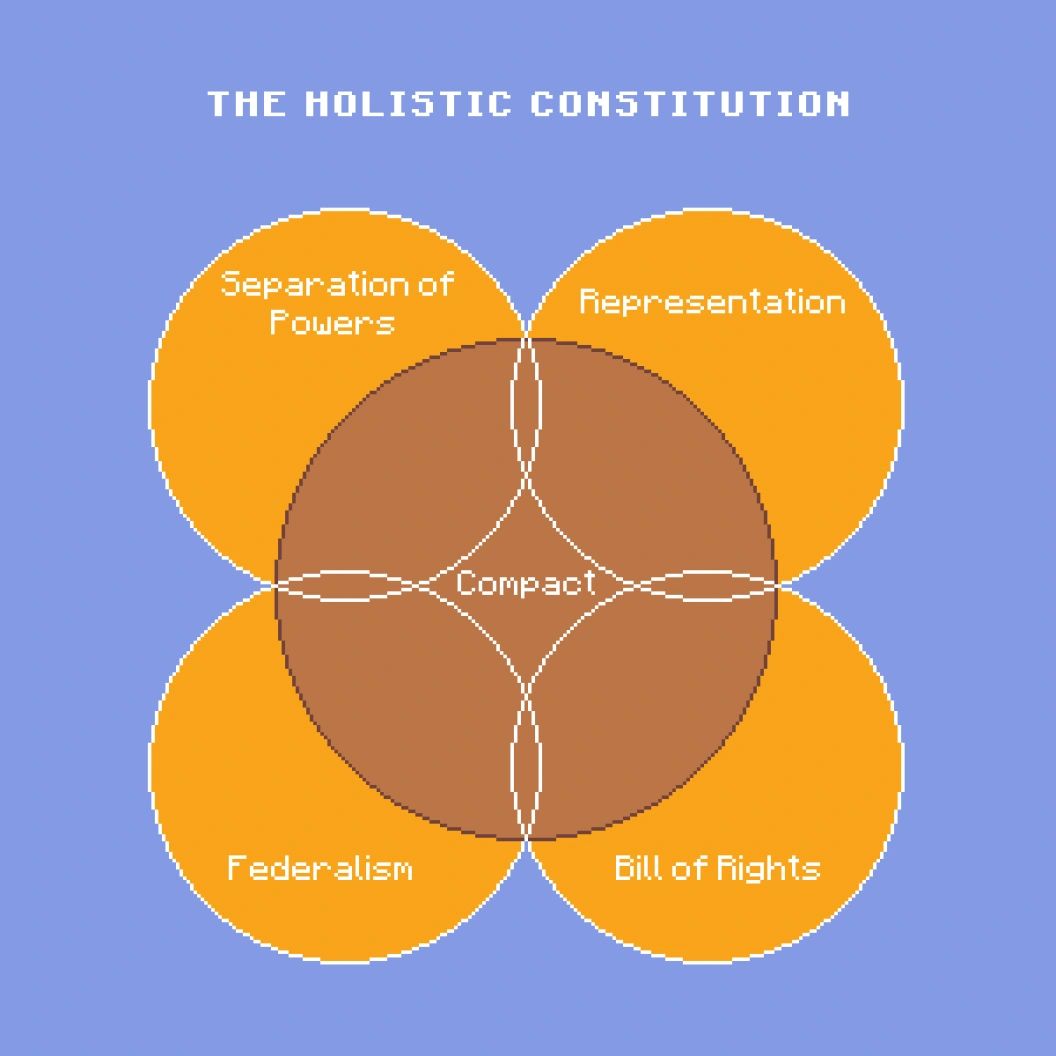
At its core, the Constitution embodies a sophisticated answer to an age-old question: How can a government be strong enough to protect its citizens yet constrained enough to preserve their freedoms? The Framers’ solution was ingenious in its complexity—a system of interlocking components that work in concert to achieve what neither monarchy nor pure democracy could accomplish alone. Each component reinforces and extends the others, creating what Sheldon terms a “Holistic Constitution”—an integrated system where structural safeguards and enumerated liberties combine to protect what the Declaration of Independence proclaimed: that governments derive their just powers from the consent of the governed, instituted to secure life, liberty, and the pursuit of happiness.
The narrative that follows is not merely historical documentation, but an examination of how carefully designed institutions can channel human ambition toward collective flourishing – while at the same time checking its capacity for tyranny. Understanding this constitutional framework remains essential for anyone seeking to comprehend how American governance functions—or how any free society might, itself, endure across generations.
On The Declaration Of Independence
Summary
While structurally not part of the Constitution, the Declaration Of Independence and the Constitution do share common philosophical roots: both documents apply John Locke’s political philosophy that the purpose of government is the protection of the lives, liberties, and properties of the people. While the Declaration of Independence used these ideas to justify overthrowing a tyrannical government, the Constitution expanded on these ideas to create a government that would defend its Citizens.
Notes
Reader note: For biographies on the signers of the Declaration of Independence, check out – ‘Who Were The Signers Of The Declaration Of Independence?‘. For a timeline of events, check out – ‘The Declaration of Independence: A Complete Timeline‘.
Notes From The Heritage Guide to the Constitution
- Part of the reason for the Constitution’s long-lasting fortitude is that it complements the Declaration of Independence.
- “The Declaration provided the philosophical basis for a government that exercises legitimate power by the ‘consent of the governed’, and it defined the conditions of a free people, whose rights and liberty are derived from their Creator.”
- “The Declaration of Independence asserts the ends of American government: equal rights and the consent of the governed for the sake of life, liberty, and the pursuit of happiness.”
Notes From American Government: Power And Purpose
- “Philosophically, the Declaration is remarkable for its assertion that certain ‘unalienable’ rights – including life, liberty, and the pursuit of happiness – cannot be abridged by governments.”
- “Politically, the Declaration is remarkable because, despite the colonists’ widely differing interests, it focused on grievances, aspirations, and principles that might unify the various colonial groups. The Declaration attempted to articulate a history and a set of principles that might help forge national unity.”
An Introduction To The Constitution
Summary
Arguably the most important work ever created on and for the governance of man, The Constitution of the United States has endured for over two centuries.
Structurally, the Constitution of the United States is introduced by the Preamble, followed by seven Articles that establish the structure of the government, and lastly, attached to the end of the Constitution, are the amendments, which are changes made to the Constitution, the first ten of which are known as the Bill of Rights (see the next section, Fundamental Components Of The Constitution, for more on the Bill of Rights).
Notes
Notes From The Heritage Guide to the Constitution
- “The Preamble has considerable potency… by virtue of its specification of the purposes for which the Constitution exists.”
- “It identifies the legal power – the union – called into existence by the Constitution and distills the underlying values that moved the Framers during their long debates…”
- “The Preamble as a whole… declares that the Constitution is designed to secure precisely the rights proclaimed in the Declaration.”
- “The Constitution delineated the structure of government and the rules for its operation, consistent with the creed of human liberty proclaimed in the Declaration.”
- “The Constitution is our most fundamental law. It is, in its own words, ‘the supreme Law of the Land.”
- “… the Constitution is the fundamental act of lawgiving which orders our politics, secures our rights, and defines our nation. It creates the institutions and practical arrangements by which we express our consent and govern ourselves.”
- “The Constitution… is and must be understood to be the standard against which all laws, policies, and interpretations should be measured. It is our fundamental law because it represents the settled and deliberate will of the people, against which the actions of government officials must be squared.”
- “The Constitution creates a government of delegated and enumerated powers.”
- “The provision for the rule of law is crucial to curbing the excesses of liberty – a strengthening of liberty’s blessings – and therefore central in fostering moral virtue.”
Notes From The Essentials Of The American Constitution
- “The Constitution… is government in action…”
- “… grants of power must not overwhelm the limits… However, the limits must not be so narrow as to prevent the government from achieving the goals that necessitated the Constitution in the first place.”
- “The Constitution is designed to check the appetite for power among officials and to create the conditions for reason to prevail.”
- “The Constitution is both instrument and symbol… The harmony between symbol and instrument is evident where government is acting within written confines, with authority and toward common goals.”
- As instrument…
- It “empowers the branches of government while also constraining them.”
- It “defines governmental structures, designates who will carry on the public’s business, endows these officials with specific powers, and sets broadly defined collective goals.”
- It “exists to energize and canalize public power.”
- It “sets goals and provides the wherewithal to achieve those goals, however broadly defined.”
- “The components of the Constitution as an instrument through which the needs of unity, justice, tranquility, defense, welfare, and liberty are to be met are separation of powers and federalism.”
- As symbol…
- It “takes on an aura of sanctity and is thereby clothed in authority and legitimacy. Such an aura compels public observance and private respect.”
- It “seems bigger than life and certainly more than a piece of parchment, and as such it helps serve to bring us together as one nation.”
- It “protect[s] and tranquilize[s] private interest or advantage against public power, which is envisaged as inherently suspect, however necessary it may be.”
- “The components of the Constitution as symbol, those that provide constitutional sanctity and authority, are the compact and the Bill of Rights. The component of representation bridges the instrument and the symbol aspects of the U.S. Constitution.”
- As instrument…
Notes From American Government: Power And Purpose
- “Any constitution contains a number of individual elements that interact to produce a specific policy making environment. These parameters determine how policy decisions are made as well as which political actors can stop them from proceeding through the process.”
- “Various provisions in the Constitution address the Framers’ concern with national unity and power, including Article IV’s provisions for comity (reciprocity) among states and among the citizens of all states.”
- “The Constitution establishes procedures for its own revision in Article V.”
- “Article VII sets forth the rules for ratification of the Constitution…”
- “A constitution ought to enable the passage of legislation and implementation of public policies, but it should not determine what that legislation or those policies ought to be.”
- “… it must be emphasized that the amendment route to social change is, and always will be, extremely limited… the arduousness of [the Constitution’s] amendment process provides durability, on the one hand, and constrains the prospects for change, on the other.”
- “Through a constitution it is possible to establish a working structure of government, and through a constitution it is possible to establish the basic rights of citizens by placing limitations and obligations on that government’s powers.”
- “No written constitution can or should prevent political change.”
- “The purpose of a constitution is to maintain boundaries, to protect the rule of law, to ensure the stability without which no economy can function, and to assure citizens that change will not take away their rights and liberties.”
Fundamental Components Of The Constitution
There are five fundamental components to the Constitution, according to ‘The Essentials Of The American Constitution’. These are the Compact, Separation of Powers, Federalism, Representation, and the Bill of Rights. “… these fundamental components of the basic law work together in resolving constitutional issues. One component reinforces, explains, or extends another…”, Sheldon states.
Now, let’s individually consider each of these five fundamental constitutional components.
1. The Compact
Summary
“That the people have an original right to establish, for their future government, such principles as, in their opinion, shall most conduce to their own happiness is the basis on which the whole American fabric has been erected. The exercise of this original right is a very great exertion; nor can it, nor ought it, to be frequently repeated. The principles, therefore, so established, are deemed fundamental. And as the authority from which they proceed is supreme, and can seldom act, they are designed to be permanent.” – Marbury v. Madison (1803)
The Compact represents the Constitution’s foundational principle and ultimate source of legitimacy—the solemn agreement rooted in popular consent that transforms a mere document into supreme law binding across generations. As Chief Justice Marshall articulated in Marbury v. Madison, the people possess an “original right” to establish governmental principles conducive to their happiness, an extraordinary exercise of sovereignty that, precisely because it represents the people acting in their supreme capacity, creates fundamental law designed for permanence rather than frequent revision.
This compact operates on dual planes: as a social compact, it forges community itself through voluntary association, establishing the bonds that unite disparate individuals into a body politic committed to governance by common laws for collective good; as a political compact, it defines the specific relationship between the people and their government, delineating what government must do, what it is forbidden from doing, and critically, preserving ultimate sovereignty in the people themselves so that governments may be altered without dissolving the social fabric that transcends any particular institutional arrangement. Consent anchors this entire edifice—it transforms abstract equality into operative political reality, thwarts arbitrary power by denying legitimacy to any authority not derived from popular agreement, and creates what scholars describe as a “vast social space” between people and limited government where individuals exercise self-governing liberty in both private and collective capacities.
Crucially, the compact embodies a sophisticated understanding of liberty’s requirements: recognizing that while individuals must relinquish certain freedoms to the collectivity (for unrestrained freedom breeds anarchy), they do so through mutual obligation—each citizen covenanting with all others and with the whole—to protect other rights and pursue collective goals, making the compact simultaneously a limitation on, and an enablement of, human flourishing.
This compact sits at the center of what constitutional scholars term the “holistic Constitution,” providing the foundational legitimacy upon which all other constitutional components—separation of powers, federalism, representation, and the Bill of Rights—ultimately rest, the wellspring of authority that makes the entire constitutional structure not merely enforceable, but morally binding on successive generations who inherit both its protections and its obligations.
Notes
Notes From The Heritage Guide to the Constitution
- “Consent is the means by which equality is made politically operable and whereby arbitrary power is thwarted. The natural standard for judging if a government is legitimate is whether that government rests on the consent of the governed.”
- “Any political powers not derived from the consent of the governed are, by the laws of nature, illegitimate and hence unjust.”
- “There exists between the people and limited government a vast social space in which men and women, in their individual and corporate capacities, may exercise their self-governing liberty.”
Notes From The Essentials Of The American Constitution
- “Consent anchors the compact.”
- “The compact, or constitutional covenant, is an open or public agreement between members who share a common bond and enjoy equal status.”
- “The compact assigns mutual obligations between the parties to the agreement – those who sign the agreement or perhaps those who give up certain private rights in order for the collectivity to protect other rights and work toward collective goals.”
- “The compact is… not part of the agreement but indeed makes that agreement valid.”
- “The compact… provides the foundation for all the other constitutional components.”
- “In a fundamental sense, it is the compact that gives the final authority to the Constitution.”
- “… not only is the compact an agreement among the parties in order to protect individual rights, but also, to that end, some freedoms must be relinquished to the collectivity… freedom without restraint can mean anarchy.”
- The compact is “of two contracts, one between the people (community) and then one between the people and the government (political society)” and should have both a social and a political dimension:
- “If the original agreement creates a social entity, community or society, it is a social compact. The preamble to the 1780 Massachusetts Constitution sets forth this concept: ‘The body-politic is formed by a voluntary association of individuals. It is a social compact, by which the whole people covenants with each citizen, and each citizen with the whole people, that all shall be governed by certain laws for the common good’.”
- “If the compact is viewed more narrowly as an agreement between the government and those being governed, it is a political compact. Such a compact legitimates government and sets forth what government is obligated to do and what it is forbidden from doing. Society (people) retains the ultimate sovereignty; this allows governments to be changed without the loss of the common bonds that hold a society together.”
- “The compact is much more than a simple agreement. The constitutional compact is fundamental. It is often referred to as the basic law, the organic law, the supreme law of the land, or the higher law. To achieve this fundamental character, the compact must embody characteristics that are special, giving it an authority far exceeding ordinary acts of government. This is achieved by two complex processes, one substantive and the other procedural.”
- “In substance… the compact is based upon… consent. A charter based on a compact that had the consent of the people surpasses in importance products of the legislature, which only represents the people indirectly. For this reason alone, the compact gives to the Constitution its primacy.”
- “The procedure by which an agreement on the compact is reached adds to the fundamental character of the Constitution. Before the compact is completed and the charter legitimated, the act of approval must progress through an extraordinarily demanding process.”
In the image below, the Compact is at the center of what is termed a “Holistic Constitution”.
2. Separation of Powers
Summary
The separation of powers represents the Framers’ elegant solution to governance’s central paradox: creating a government robust enough to maintain order and pursue collective goals, yet constrained enough to prevent the concentration of power that inevitably breeds tyranny.
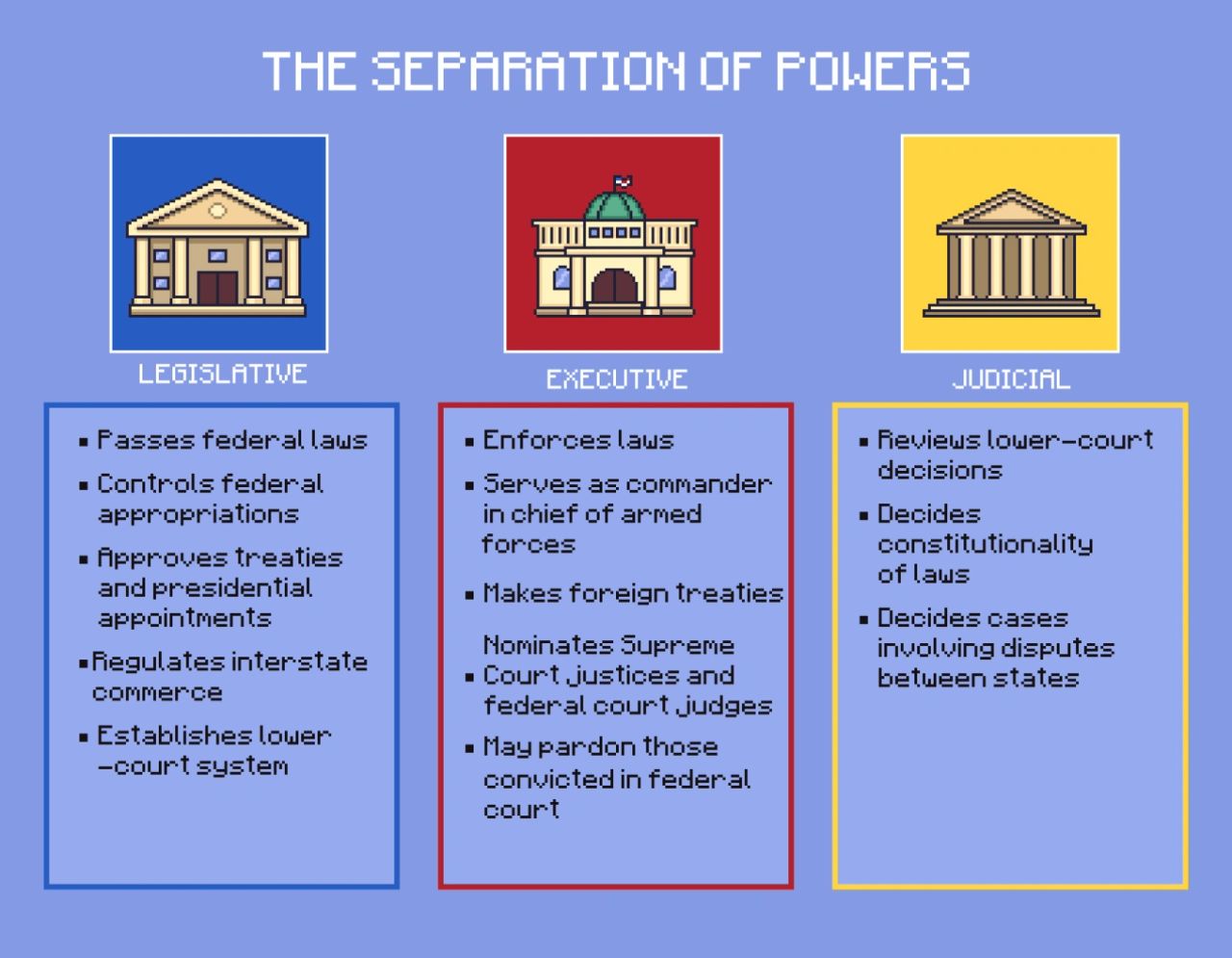
This architectural principle operates through a deliberate diffusion of authority—horizontally across three coordinate branches of equal rank (legislature, executive, and judiciary), each wielding distinct powers while remaining bound by constitutional interpretation, and vertically between federal and state governments in a federal arrangement we’ll explore later. Rather than absolute independence, the system cultivates what might be called “competitive interdependence”: the legislative branch makes laws with the most direct democratic legitimacy, the executive executes those laws while commanding military and diplomatic apparatus, and the judiciary resolves disputes while interpreting constitutional meaning—each branch simultaneously empowered and checked, each accountable to different constituencies (popular vote for the House, electoral college for the President, state legislatures originally for the Senate, and presidential appointment for judges), thus ensuring that diverse perspectives and interests shape governance.
Notes
Notes From The Heritage Guide to the Constitution
- “… limited government is not just a desirable objective; it is the essential bedrock of the American polity… you must first enable the government to control the governed; and in the next place oblige it to control itself.”
- “By seeking the results of the competition of ideas in the marketplace, government is provided with guidelines for policies…”
- “By the diffusion of power – horizontally among the three separate branches of the federal government and vertically in the allocation of power between the central government and the states – the Constitution’s Framers devised a structure of government strong enough to ensure the nation’s future strength and prosperity but without sufficient power to threaten the liberty of the people.”
- “The separation of powers frustrates designs for power and at the same time creates an incentive to collaborate and cooperate, lessening conflict and concretizing a practical community of interest among political leaders.”
- “Each of the three coordinate branches of government created and empowered by the Constitution – the executive and legislative no less than the judicial – has a duty to interpret the Constitution in the performance of its official functions.”
- “The Constitution creates three branches of government of equal ‘rank’ in relation to each other. No branch is higher or lower than any other, and no branch controls the others; each has independent authority and unique powers. The order – legislature, executive, judiciary – is important, however, moving from the most to the least ‘democratic’ (that is, from the most to the least directly chosen by the people). The Constitution lodges the basic power of government in the legislature not only because it is the branch most directly representative of popular opinion, but also because the very essence of governing according to the rule of law is centered on the legitimate authority to make law.”
- “Written constitutionalism implies that those who make (the legislature), adjudicate (the courts), and enforce (the executive) the law… be guided by the meaning of the United States Constitution… as it was understood by those who wrote and ratified the Constitution and its amendments.”
- “The Constitution divides and allocates governmental powers, not governmental functions or actions.”
- “Separation of Powers is a fixture of the federal constitutional system even as its contours are uncertain and contested.”
- “At the core, the legislative power makes laws, the executive power executes them, and the judicial power resolves disputes between parties.”
Notes From The Essentials Of The American Constitution
- “From a theoretical perspective, division of powers represents a compromise between democracy and republicanism.”
- “Accountability, liberty, experimentation, participation, and protection against tyranny are regarded as attributes of… division between governments.”
- “In designing the structure of our Government and dividing and allocating the sovereign power among three co-equal branches, the Framers of the Constitution sought to provide a comprehensive system, but the separate powers were not intended to operate with absolute independence.”
Notes From American Government: Power And Purpose
- “The Framers of the Constitution understood that well-designed institutions make it easier to achieve collective goals… Accordingly, the Framers took great care to construct institutions that, over time, would help the nation accomplish certain important political purposes… inspir[ing] such constitutional principles as bicameral legislature (the division of Congress into two chambers)… [,] separation of powers and federalism.”
- “… the separation of powers enables several different federal institutions to influence the nation’s agenda, to affect decisions, and to prevent the other institutions from taking actions – dividing agenda, decision, and veto power. The Constitution’s framers saw this arrangement, although cumbersome, as an essential means of protecting liberty.”
- “Another feature of the separation of powers is the principle of giving each branch a distinctly different constituency, what theorists… called a ‘mixed regime’… Because each branch is held accountable by a different group, the members of each branch… develop very different outlooks on how to govern, definitions of the public interest, and alliances with private interests.”
- The President is chosen indirectly by electors, an Electoral College
- The House of Representatives is chosen by popular vote
- The Senate was originally chosen by state legislatures (now by popular vote)
- The Judiciary is chosen by the presidential appointment
In the image below, the basics of the separation of powers between the three branches of government are highlighted.
2.a. The Legislative Branch: creates the “Congress”
Summary
Congress stands as the Constitution’s preeminent branch, embodying legislative supremacy through a bicameral structure that requires both the House of Representatives and Senate to approve legislation—a design that transforms representation into lawmaking authority while distributing power across two distinct chambers with different constituencies and temporal rhythms.
The Framers vested in Congress what political theorists recognize as government’s two most fundamental powers: the power of the purse and the power of the sword. Beyond these twin pillars of money and force, Congress wields crucial checks on the other branches: creating lower courts and adjusting Supreme Court composition, impeaching officials, promoting science through intellectual property protections, and—perhaps most significantly—overriding presidential vetoes through supermajority vote. This concentration of enumerated powers reflects the Framers’ conviction that legitimate governance flows most directly from popular representation, making the legislature not merely first among equals, but the constitutional engine through which the people’s will transforms into binding law.
Notes
Notes From The Heritage Guide to the Constitution
- The powers of the Legislature are vested in a Congress of the United States that is separated into two sources of representation – the Senate and the House of Representatives.
Notes From American Government: Power And Purpose
- The Congress:
- “Within the system of separated power, the Framers provided for legislative supremacy by making Congress the preeminent branch.”
- “The first seven sections of Article 1 of the Constitution provide for a Congress consisting of two chambers – a House of Representatives and a Senate… the enactment of law requires the approval of both chambers”
- “The U.S. Congress is not only a representative assembly. It is also a legislative body. For Americans, representation and legislation go hand in hand.”
- The powers of Congress: see also the information on the House and Senate in section on Representation
- “Congress controls a formidable battery of powers that it uses to shape policies and, when necessary, defend its prerogatives against the executive branch.”
- “Congress has bast authority over the two most important powers given to any government: the power of force (control over the nation’s military forces) and the power over money.”
- “Article 1, section 8, lists the specific powers of Congress…”
- Power over money:
- Power over force:
- The authority to provide for the common “Defense and general Welfare”
- The authority to declare war and deal with piracy
- The authority to maintain an army and navy
- The authority to raise and regulate the armed forces and military installations
- The authority to acquire and control federal lands
- Judicial Power:
- The power to create inferior (lower) courts
- The power to change the size of the Supreme Court
- The power of impeachment
- The authority to promote science and “useful arts” – pertaining primarily to patents, trademarks, and copyrights
- Congress has veto power – By two-thirds vote Congress can override the President’s veto
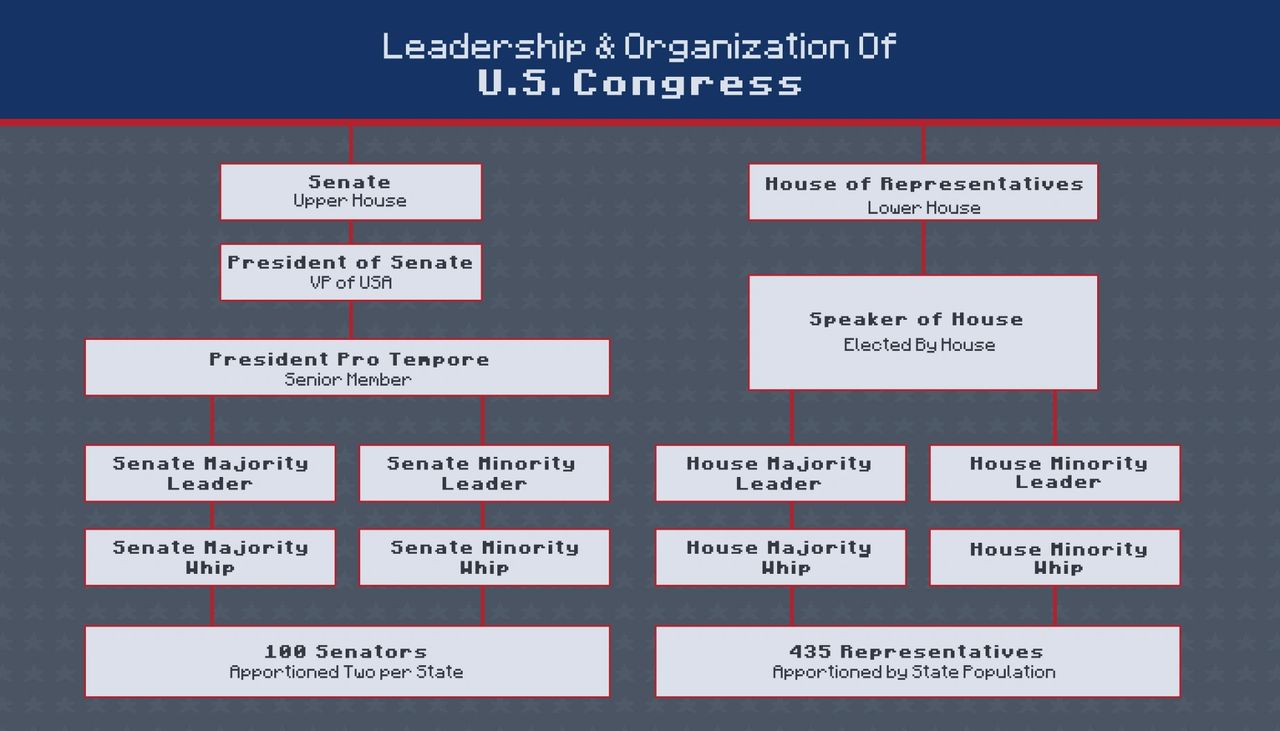
The image below illustrates the hierarchy of the U.S. Congress, detailing the organization of the leadership structure.
2.b. The Executive Branch: creates the “President”
Summary
The presidency, established in Article II of the Constitution, emerges as the constitutional embodiment of executive energy—a singular office designed to provide the federal government with the capacity for swift, decisive action while remaining sufficiently insulated from populist pressures through indirect election via the Electoral College.
The Framers engineered a complex taxonomy of presidential powers spanning multiple domains: expressed powers constitutionally enshrined beyond congressional revocation, including Commander in Chief authority over military forces; judicial powers to grant pardons and reprieves; diplomatic powers to negotiate treaties and recognize foreign governments; executive powers to faithfully execute laws and appoint departmental personnel and Supreme Court justices; legislative powers to veto congressional acts and convene special sessions; delegated powers assigned by Congress for implementing statutory will; and inherent powers derived from the office’s fundamental rights and obligations. Yet this formidable arsenal operates within a framework of institutional interdependence captured in the maxim “the president proposes; the Congress disposes”—treaties require Senate ratification, appointments demand confirmation, and vetoes remain vulnerable to congressional override through supermajority vote.
This architecture reflects a calculated tension: the presidency must possess sufficient authority to lead the nation through crisis and complexity, channeling federal power with an immediacy that bicameral deliberation cannot match, while remaining fundamentally accountable to both constitutional constraints and the separated powers that continuously test and temper executive ambition.
Notes
Notes From American Government: Power And Purpose
- “The Constitution establishes the presidency in Article II.”
- “Article II, Sections 2 and 3, outline the powers and duties of the president.” The powers of the Executive include:
- Expressed powers: “… clearly defined powers, called the expressed powers of the office, cannot be revoked by Congress or any other agency without an amendment to the Constitution.”
- Military powers: Provides for the of the President as Commander in Chief of the Army and Navy
- Judicial powers: The power to grant reprieves and pardons, except in cases of impeachment
- Diplomatic powers:
- The power to negotiate treaties subject to Senate approval
- The unconditional power to accept ambassadors from (essentially to “recognize”) other countries
- Executive powers:
- Authorizes the President to see to it that all the laws are faithfully executed
- The power to appoint major departmental personnel
- The power to appoint judges to the Supreme Court, subject to Senate approval
- Legislative powers:
- The power to participate authoritatively in the legislative process
- The power to convene Congress in a special session
- The power to veto congressional enactments, legislation passed by Congress (the veto power is not absolute, because Congress can override it by a two-thirds vote)
- Delegated powers: “… Congress is to delegate to the president the power to implement or execute its will,” those laws enacted by Congress.
- Inherent powers: “… inherent powers are not specified in the Constitution or the law but are said to stem from ‘the rights, duties, and obligations of the presidency.”
- “The president proposes; the Congress disposes. That is, the president may propose certain items to the legislature as outlined in the Constitution, such as a treaty, a major departmental appointment, or a federal judge or justice, which are then subject to the approval by the Senate.”
- “The Framers hoped to create a presidency that would give the federal government, rather than the states, the energy to take timely and decisive action to deal with public issues and problems. At the same time, however, the Framers wanted the president to be able to withstand democratic pressures, so they designed the office to be subject to indirect election through the Electoral College.”
- “The strongest presidents are both elected and have a veto.”
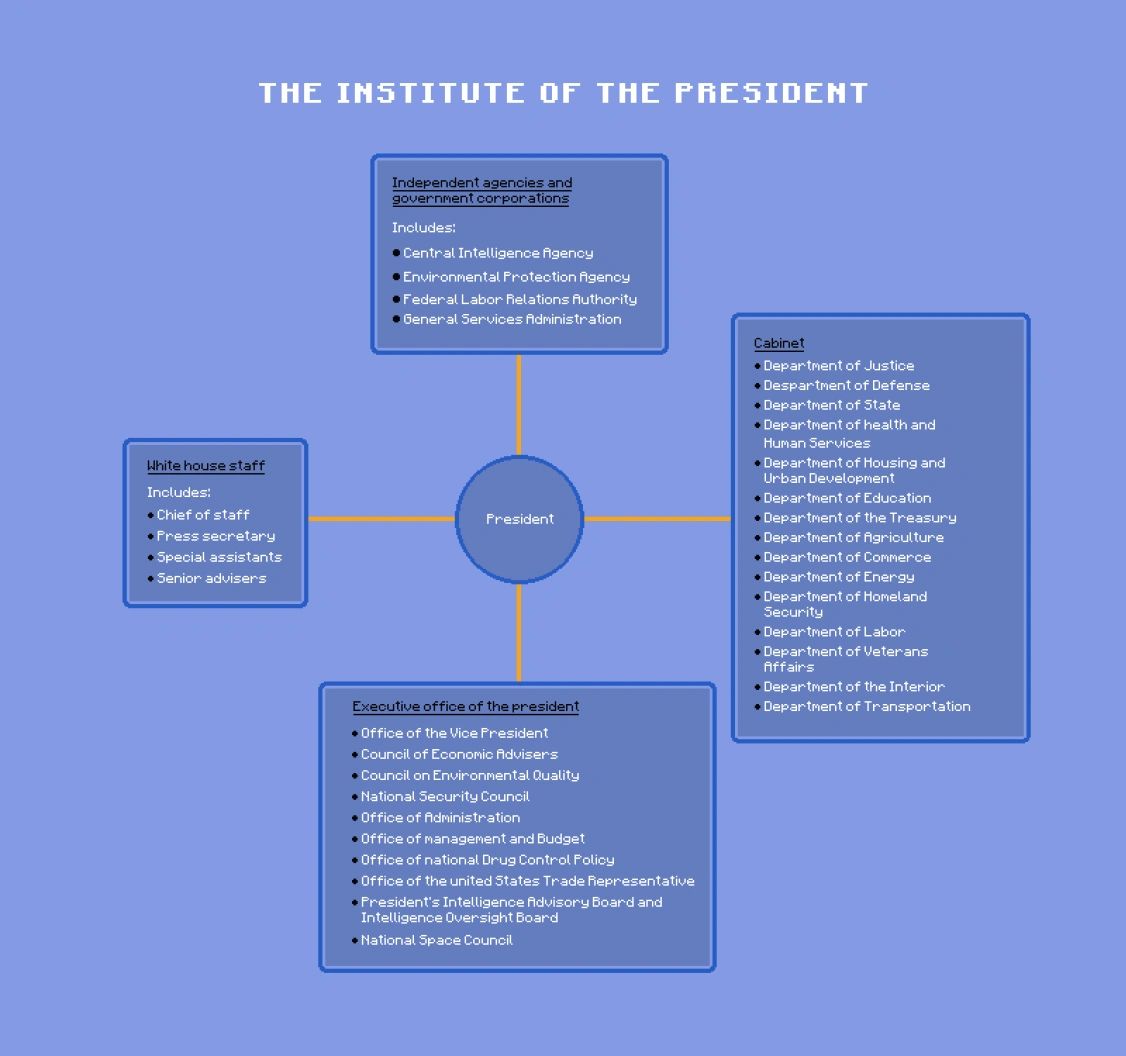
The “institute” that has become the office of the President is illustrated in the image below.
2.c. The Judicial Branch: creates the “Supreme Court”
Summary
The judicial branch, established in Article III, is – paradoxically – a profoundly political institution deliberately insulated from politics through lifetime appointment, designed simultaneously to enhance national governmental power, restrain democratic excess, and safeguard individual liberty and property against governmental encroachment.
The Framers conceived not merely the apex of a national court hierarchy, but a literally supreme tribunal—superior to both federal and state judiciaries—vested with jurisdiction over interstate disputes and, most significantly, the power of judicial review: the authority to measure presidential actions, congressional legislation, and state laws against constitutional standards – and void those found wanting. This power of judicial review, nowhere explicitly mentioned in the constitutional text itself, emerged through interpretive consensus as the logical corollary of written constitutionalism—if the Constitution represents supreme law, then courts exercising jurisdiction over “all Cases arising under this Constitution” must necessarily possess authority to determine what that law means and whether governmental actions conform to it. The judiciary thus functions as dispute resolver, rule interpreter, and constitutional guardian, wielding what Alexander Hamilton called “neither force nor will, but merely judgment,” yet capable through that judgment of reshaping the boundaries between federal and state power.
Notes
Notes From American Government: Power And Purpose
- “Article III of the Constitution, which establishes the judicial branch, reflects the Framers’ preoccupations with enhancing the power of the national government, checking radical democratic impulses, and preventing the government from interfering with the liberty and property rights of its citizens.”
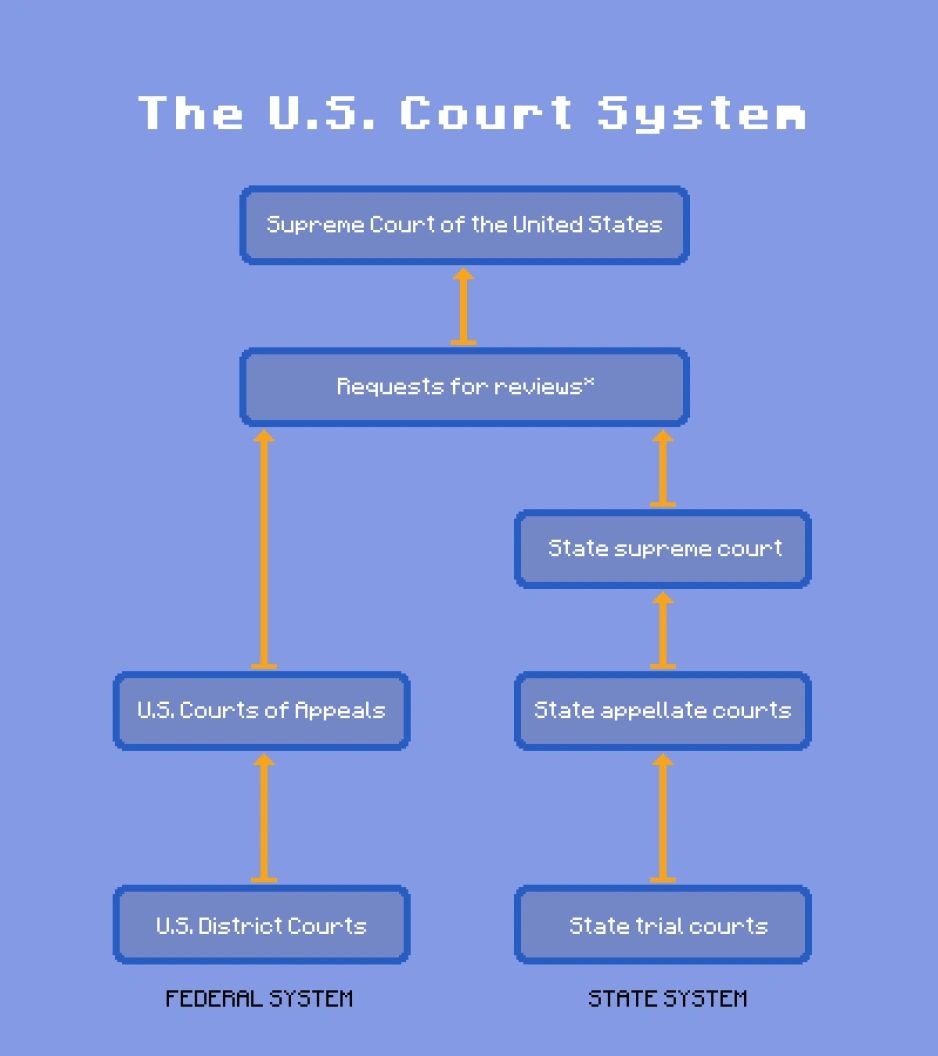
- “The Framers created a court that was to be literally a supreme court of the United States, not merely the highest court of the national government.”
- “The Constitution stipulates that federal judges must hold lifetime appointments, a provision that protects them from popular politics and interference from the other branches.”
- Courts function as political institutions in their “role as dispute resolvers, coordinators, and interpreters of rules.”
- The powers of the Supreme Court include:
- The right to determine whether a power is exclusive to the federal government, concurrent with the states, or exclusive to the states
- Jurisdiction over controversies between citizens of different states
- Judicial review – the power of the courts to determine whether the actions of the president, Congress, and the state legislatures are consistent with the Constitution
- Note that the Constitution makes no mention of judicial review
- “Scholars generally feel that judicial review is implicit in the existence of a written constitution and in the power given to the federal courts over ‘all Cases… arising under this Constitution’ (Article III, Section 2).”
The image below illustrates how federal and state court systems work together to create the U.S. Court System. Note that the Supreme Court is, literally, supreme.
2.d. Checks & Balances
Summary
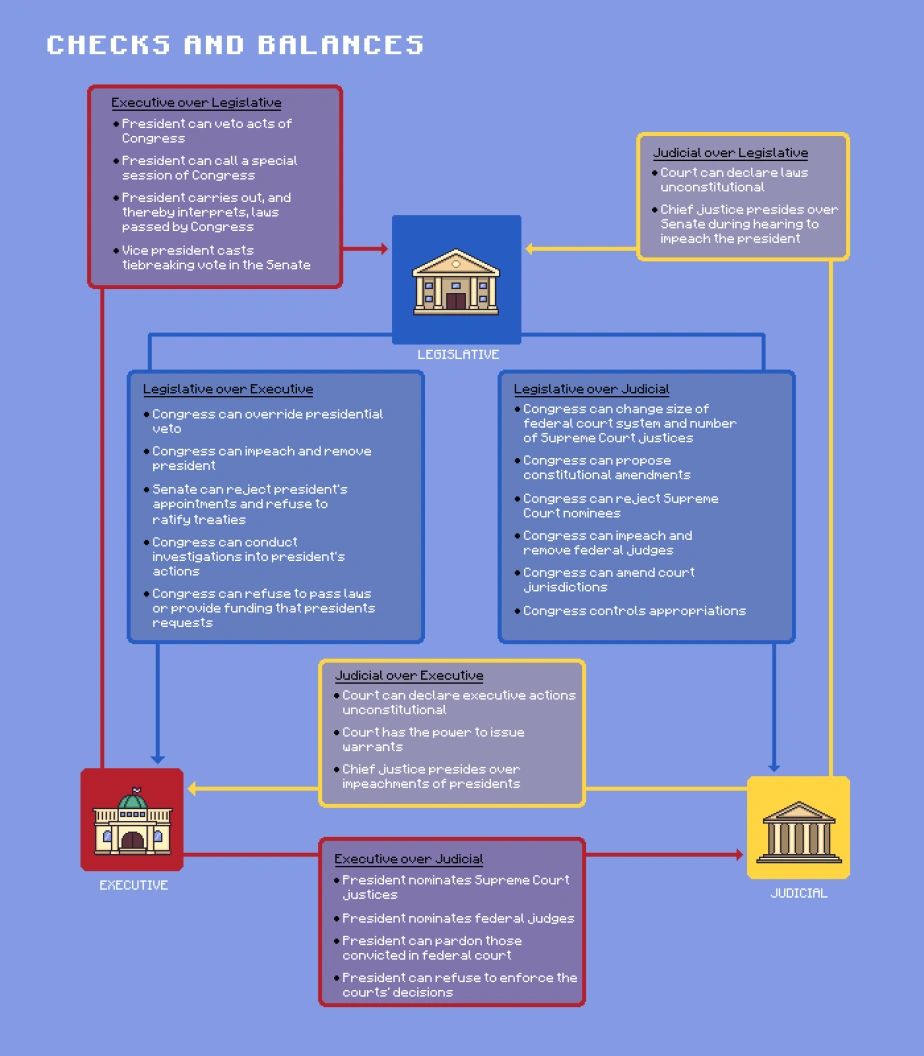
But, as said in ‘American Government: Power And Purpose’, “… separation of powers is nothing but mere words on parchment without a method to maintain the separation. The method laid out in the Constitution became known as ‘checks and balances’. Each branch has not only its own powers but also some power over the other two branches.” The Framers’ goal was that the three branches would use the system of checks and balances against one another in order to create a more competitive, enduring, and perfect system.
Notes
The image below illustrates the system of checks and balances enabled by the Constitution.
3. Federalism
Summary
Federalism stands alongside separation of powers as a foundational pillar of American constitutional architecture, representing what scholars have hailed as the nation’s singular contribution to the art of governance—a vertical division of sovereignty that complements the horizontal distribution among branches by splitting governmental authority between national and state levels in a dynamic system of competitive equilibrium.
The Framers engineered this dual sovereignty not as a concession to state interests, but as a deliberate strategy for liberty preservation: by creating two tiers of government that simultaneously check each other while remaining internally constrained, they erected what Madison called a “double security” for individual rights, ensuring that power concentration at any single level would face resistance from the competing sovereign.
Notes
Notes From The Heritage Guide to the Constitution
- “The institutional design [of Federalism] was to divide sovereignty between two different levels of political entities, the nation and the state. This would prevent an unhealthy concentration of power in a single government [and] a double security to the rights of the people.”
- “Federalism, along with separation of powers, the Framers thought, would be the basic principled matrix of American constitutional liberty. The different governments… control each other, at the same time that each [is] controlled by itself.”
- “… federalism can contribute to a sense of political community, and hence to a kind of public spirit, that is too often ignored in our public discussion about federalism. But in a sense it is this understanding that makes the American experiment in popular government truly the novel undertaking the Framers through it to be.”
- “… federalism is the basic operational structure of American constitutional government as a whole and provides the process by which the two levels of government check each other.”
Notes From The Essentials Of The American Constitution
- “Federalism has been regarded as America’s greatest contribution to the art of governing.”
Notes From American Government: Power And Purpose
- “… federalism was a step toward greater centralization of power. Seeking to place more power at the national level without completely undermining the power of state governments, the Framers devised a system of two sovereigns, or supreme powers – the states and the nation – with the hope that competition between the two would limit the power of both.”
- “Federalism assigns agenda, decision, and veto powers to the federal government and to each of the 50 states.”
- “The constitution reifies the principle of federalism by recognizing two sovereign powers: it grants a few expressed powers to the national government and reserves the rest to the states.”
- “One way in which the Framers preserved a strong role for the states was through the Tenth Amendment… The Tenth Amendment is also called the ‘reserved powers’ amendment because it aims to reserve powers to the states… powers the Constitution does not delegate to the national government or deny to the states are ’reserved to the States respectively, or to the people’.”
- “A state’s authority… encompasses its power to regulate the health, safety, welfare, and morals of its citizens.”
- Powers exercised by the States are commonly referred to as the ‘police power’. “Policing is what States do – they coerce individuals in the name of the community in order to maintain public order.”
- Powers of the States include:
- The power to develop and enforce criminal codes
- The power to administer health and safety codes
- The power to regulate family via marriage and divorce laws
- The power to regulate individuals livelihoods – the practice of a host of occupations requires an appropriate license from the State
- The power to define private property
- The power of eminent domain
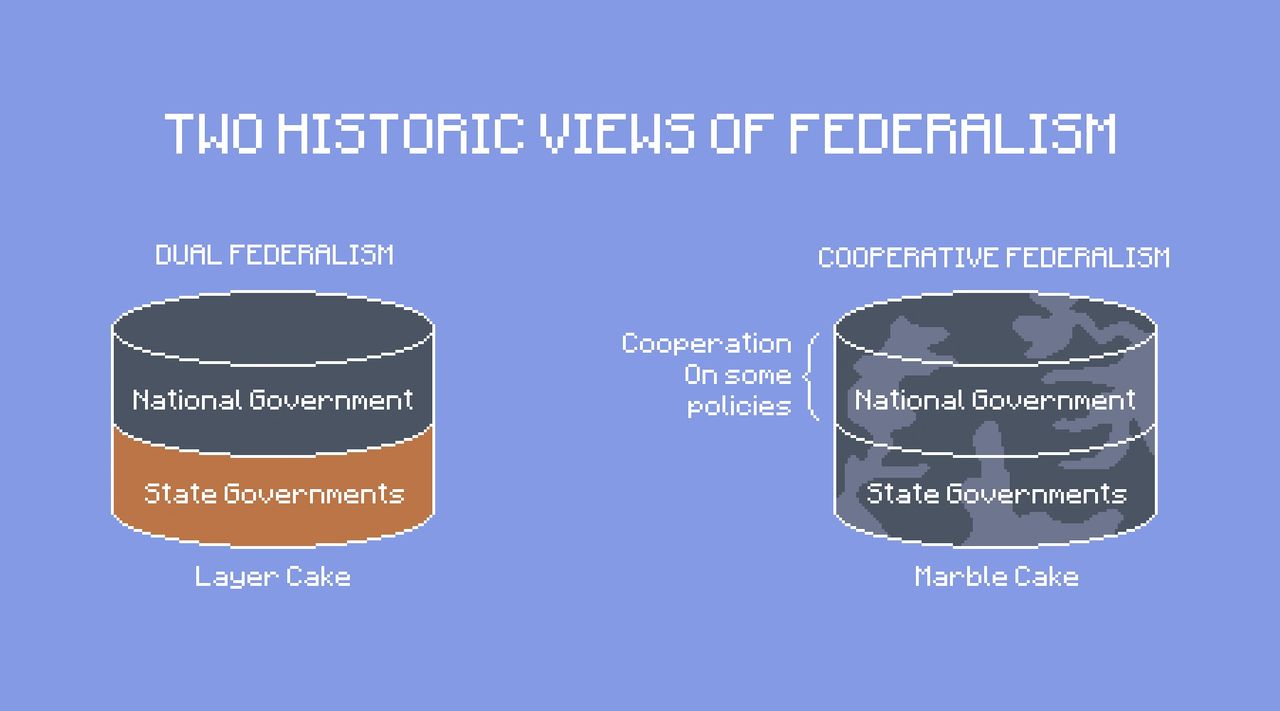
- In actual execution, the separation of State and federal powers, or “Federalism”, has shifted over the years from the system of dual sovereignty established by the Framers to a system of “Cooperative Federalism”, what political scientists commonly call our post-New Deal, marblecake-like, system of Federalism – one in which it is difficult to clearly establish where the national government ends and the state and local governments begin. In fact, according to ‘American Government: Power And Purpose’, “Today, federal aid accounts for 31 percent of state and local budgets.”
The image below illustrates the two historical views of Federalism – the Dual Federalism of the Framers and our current system of Cooperative Federalism.
4. Representation
Summary
Representation is the Constitution’s ingenious mechanism for translating the messy plurality of American interests into coherent governmental action, operating through a bicameral architecture that deliberately fragments representative authority to ensure that legislation emerges only after navigating multiple democratic filters with fundamentally different geometries.
The House of Representatives—designed as the people’s chamber with two-year terms that force continual electoral accountability—expands proportionally with population growth, originates all revenue legislation, and organizes itself through specialized committees where members develop policy expertise tailored to specific local and regional interests; this structural proximity to constituents transforms Representatives into responsive agents of well-organized interest groups seeking concrete legislative outcomes.
The Senate, by contrast, was conceived as a more aristocratic institution (originally appointed by state legislatures, now popularly elected – but retaining six-year staggered terms that make it a “continuing body” never wholly reconstituted), granting equal representation to all states regardless of size and vesting it with unique powers over treaties and presidential appointments; Senators serve larger, more heterogeneous constituencies spanning entire states, making them conduits for broader coalitions and statewide interests while the chamber’s deliberative traditions permit more thorough vetting of ideas than the House’s procedurally streamlined operations allow.
This bicameral duality creates what the Framers intended as a “mixed regime”—the House channeling democratic energy and popular passion through frequent elections and direct fiscal control, the Senate tempering that energy with longer tenure and institutional memory, each chamber serving as a check on the other’s excesses, while together ensuring that successful legislation carries legitimacy from multiple representative sources. The system’s genius lies not in perfect representation of any single interest, but in forcing coalition-building across geographic scales, temporal horizons, and constituent types—a representational friction that frustrates narrow agendas while channeling diverse voices toward policies capable of surviving scrutiny from radically different democratic perspectives.
Notes
Notes From The Heritage Guide to the Constitution
- The Constitution created a bicameral system that “required that all legislation would have to be ratified by two independent power sources” of representation:
- Representatives of the people in the House of Representatives
- Representatives of the states (regardless of their respective size) in the Senate
- The House of Representatives:
- “The Framers… decided to address inequities in representation by leaving it to Congress’s discretion to ‘alter’ the ‘Times, Places and Manner’ of choosing Members (Article 1, Section 4).”
- Representatives “increase [in] number… as the population [grows].”
- The Senate:
- “Equal representation of all states in the Senate ensured that the ability of the smaller states to protect their interest would not be seriously impaired.”
- The Senate is a “continuing body”.
- Representatives must:
- Be a safe “depository of the public interests”
- “Possess a proper knowledge of the local circumstances of their numerous constituents”
- Not “be taken from that class of citizens which will sympathize less with the feelings of the mass of the people, and be most likely to aim at a permanent elevation of the few on the depression of the many”
Notes From American Government: Power And Purpose
- “Congress is the most important representative institution in American government.”
- The House of Representatives:
- “Members of the House of Representatives hold two-year terms of office…”
- “The House has the sole power to originate revenue bills.”
- “All money bills – that is, bills authorizing new taxes or authorizing the government to spend money for any purpose – are required to originate in the House.”
- “The House is the more centralized and more organized body: it is better equipped to facilitate governmental processes.”
- “House members specialize in certain policy areas, their specialized activities take place mainly in committees, and deliberations by the full House occur mainly in response to committee proposals.”
- “… members of the House more effectively and more frequently serve as the agents of well-organized local interests with specific legislative agendas… the frequency with which they must seek re-election make House members more attuned than Senators to the legislative needs of local interest groups.”
- The Senate:
- “Members of the Senate [are] appointed for six-year terms. These terms are staggered so that the appointments of one-third of the Senators expire every two years.”
- “… the Senate alone can ratify treaties (by a two-thirds vote) and approve presidential appointments.”
- “… the Senate has the power to approve… the appointment of ambassadors.”
- “The Framers intended for Senators to represent the elite members of society and to be attuned more to the interests of property than to those of the population.”
- “The Senate is a more deliberative body: it is the forum in which all ideas can receive a thorough public airing.”
- “Senators… serve larger and more heterogeneous constituencies. As a result, they are better able than members of the House to serve as the agents of groups and interests organized on a statewide or national basis.”
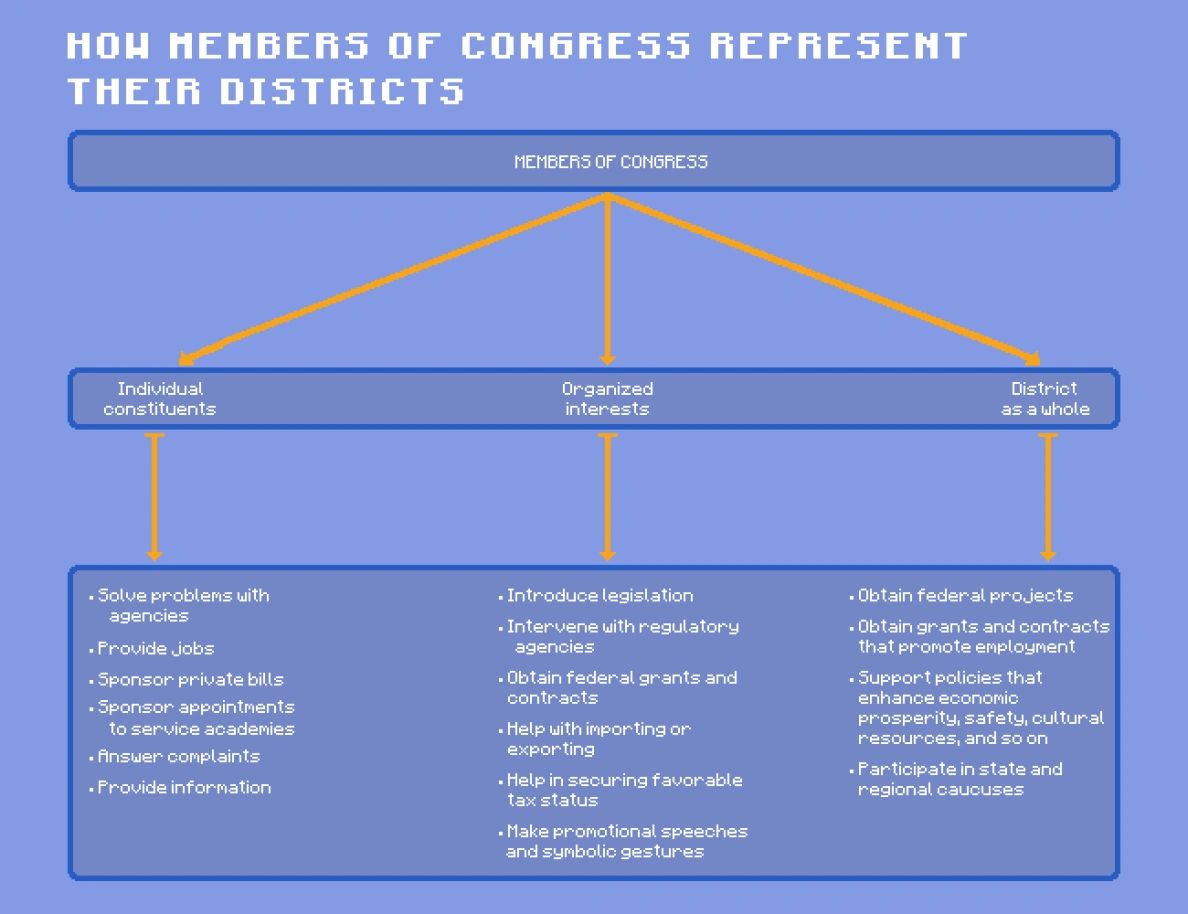
Below the reader will find an image illustrating how members of Congress represent their constituencies.
5. The Bill Of Rights
Summary
The Bill of Rights—the Constitution’s first ten amendments—stands as perhaps the most consequential catalogue of human liberty ever codified, a deliberate withdrawal of certain fundamental domains from the volatile theater of majoritarian politics and governmental discretion, establishing instead judicially enforceable principles that exist beyond electoral mandate or legislative caprice.
Yet the Bill of Rights transcends mere enumeration—the Ninth Amendment explicitly warns against interpreting this catalogue as exhaustive, declaring that unlisted rights remain with the people, while the Tenth Amendment reserves to states and citizens all powers not delegated to the federal government, together forming what scholars call the Constitution’s “twofold theory”: rights emerge not from governmental grant, but from human nature itself, and federal authority extends only as far as popular consent explicitly reaches.
Notes
Notes From The Heritage Guide to the Constitution
- “Madison… wanted the amendments that became the Bill of Rights to be interwoven into the relevant sections of the Constitution. More for stylistic rather than substantive reasons, though, Congress proposed (and set the precedent for) amendments appended separately at the end of the document. Some have argued that this method makes amendments more susceptible to an activist interpretation than they would be otherwise.”
- The Bill of Rights is encompassed in the first ten Amendments to the Constitution
- Substantive political rights granted by the Bill of Rights:
- “The First Amendment guarantees substantive political rights involving religion, speech, press, assembly, and petition, recognizing certain areas that are to be free from federal government interference.”
- “The Second Amendment guarantees an individual right to keep and bear arms.”
- Procedural rights granted by the Bill of Rights:
- The Third through Eighth Amendments “deal with more procedural rights, mostly restraints on criminal procedure that regulate the exercise of government’s law enforcement power so that it is not arbitrary or excessive.”
- Property protections granted by the Bill of Rights:
- “The Bill of Rights includes important property protections… protection of property is both a substantive and a procedural right guaranteed by the Constitution.”
- “The Second Amendment prohibits confiscation of arms…”
- “… the Third Amendment prohibits the lodging of troops in any home.”
- “The Fourth Amendment prohibits unreasonable searches and seizures of persons, homes, papers, and effects…”
- “… the Eighth Amendment prohibits excessive bail and fines, as well as cruel and unusual punishment, an additional protection of property in one’s person.”
- “Most importantly, of course, the Fifth Amendment says that no person shall ‘be deprived of life, liberty, or property, without due process of law; nor shall private property be taken for public use, without just compensation.”
- “The Ninth and Tenth Amendments briefly encapsulate the twofold theory of the Constitution and address the confusion (which was Madison’s concern) that may arise in misreading the other amendments to imply unlimited federal powers: The purpose of the Constitution is to protect rights that stem not from the government but from our human nature and thus belong to the people themselves, and to limit the powers of the national government to those delegated to it by the people through the Constitution.”
Notes From The Essentials Of The American Constitution
- “The politics surrounding provisions of the Bill of Rights focus on what freedoms are to be retained by the individual and what demands society can make on individual freedoms.”
- “It is the purpose of the Bill of Rights to create and maintain the optimum conditions for the exercise of reason. In order to make decisions about our political fate, we must be able to read, write, worship, gather together with others to discuss issues, and, if need be, act upon decisions by petitioning government. Experimenting, contemplating, and reasoning without intervention from government are also encouraged by a high degree of privacy.”
- “The Bill of Rights… has two dimensions: procedural or substantive, and communitarian, or individualistic.”
- “The very purpose of a Bill of Rights [is] to withdraw certain subjects from the vicissitudes of political controversy, to place them beyond the reach of majorities and officials to establish them as legal principles to be applied by courts. One’s fundamental rights may not be submitted to vote; they depend on the outcome of no elections.”
- “Interdependence, not independence, dictates the focus of rights.”
- Substantive Rights:
- “… substantive rights remain paramount for a free individual and a free society. The function of government is to observe these rights and, if necessary, to intervene if those rights are threatened.”
- “Substantive rights are viewed as universal…”
- Procedural Rights:
- “When confronted with the power of government or when relying on the legal system for redress, individuals are to be treated equally and fairly. Procedural rights are designed to assure that the justice system, civil or criminal, treats all alike.”
- “… procedural rights depend… on the need for diversity and experimentation…”
Notes From American Government: Power And Purpose
- “… the Bill of Rights has proved for over two centuries to be a bulwark of civil liberty in the United States.”
- “The purpose of the 10 amendments in the Bill of Rights was to give each of the three branches clearer and more restricted boundaries.”
- The Bill of Rights is a bill of civil liberties, focused on what the government must not do – “protections of citizens from improper governmental action”, “restraints addressed to government, limiting its jurisdiction”, and “what people are entitled to against every government on earth”.
- “Because liberty requires restraining the power of government, the general status of civil liberties can never be considered fixed and permanent.”
- “… civil rights ought to be universal: all persons should enjoy them. Second, civil rights ought to be equal: all people who enjoy a civil right ought to be allowed an equal ability or opportunity to practice that right.”
- “Perhaps the most basic civil right in any country is the right to be in the country to begin with.”
- “A wide range of economic and civil activities are… governed by civil rights.”
- “The Constitution identifies a small number of civil rights. The Bill of Rights asserts a larger number of legal rights.”
- “Both civil liberties and civil rights are solutions to collective action problems. Strengthening the former means imposing more restrictions on some form of collection action. Expanding the latter means allowing more individuals to take part in collection decision making and imposing restrictions on the sort of decisions that can be reached.”
- Civil rights illustrate “history… in action.”
- “… in practice, several provisions of the Bill of Rights assert both a liberty and right.”
- “The Bill of Rights… defines those areas of political, economic, and social existence that are beyond the concern of government.”
- “A Bill of Rights is what the people are entitled to against every government on earth, general or particular, and what no just government should reuse, or rest on interference.”
- “The Ninth Amendment addresses [the] concern, declaring that the Constitution’s enumeration of some rights ‘shall not be construed’ to mean that the people do not retain other rights as well.”
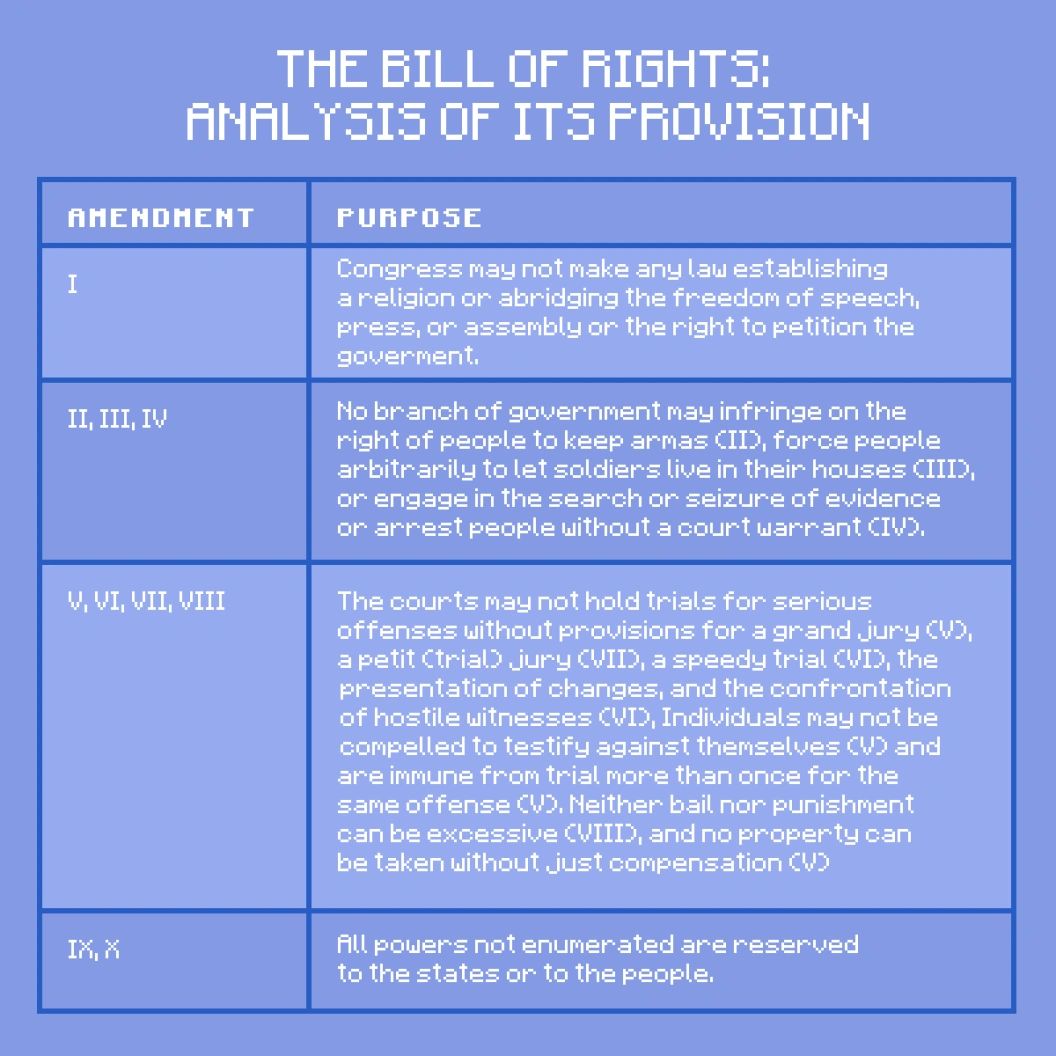
The table below gives a brief analysis of the provisions in the Bill of Rights.
Lawmaking, or: How Does A Bill Become A Law?
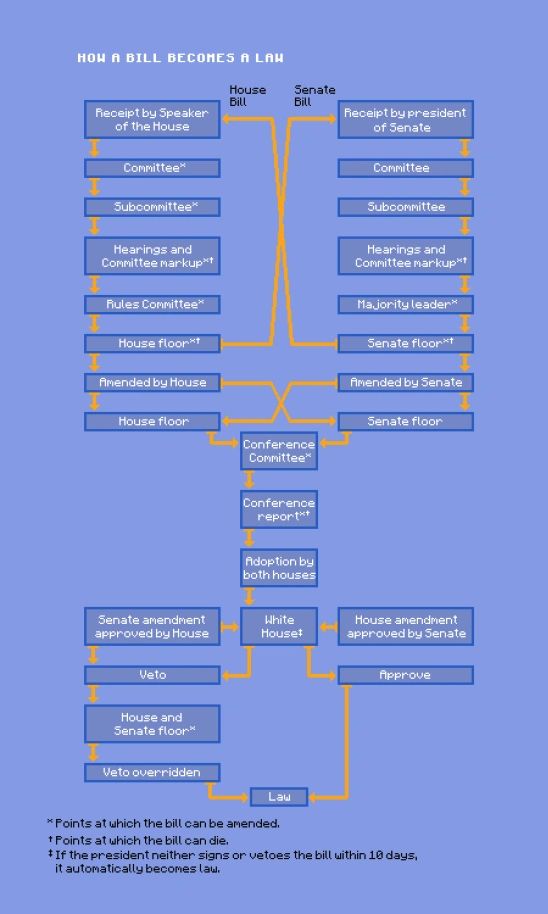
Lawmaking is the process of creating laws through a formal procedure by a branch of government. The process involves several stages, including:
- Idea: A representative sponsors a bill based on an idea
- Study: The bill is assigned to a committee for study
- Debate: If the committee releases the bill, it is debated and voted on
- Conference: If the bill passes in both the House and Senate, a conference committee works out any differences between the two versions
- Final approval: The bill returns to both the House and Senate for final approval
- Enrolling: The Government Publishing Office prints the revised bill
- Signing or veto: The President has 10 days to sign or veto the bill
The image below illustrates the process of how a bill becomes a law.
Final Thought
The Constitution and the government it establishes “has a just claim to [our] confidence and respect… [it’s] the offspring of our choice, uninfluenced and unawed, adopted upon full investigation and mature deliberation, completely free in its principles, in the distribution of its powers uniting security with energy, and containing, within itself, a provision for its own amendment.” – from the 1796 Farewell Address of George Washington
George Washington’s 1796 Farewell Address captured something profound about the constitutional achievement—this was not a document imposed by conquest or inherited through monarchical succession, but rather “the offspring of our choice, uninfluenced and unawed, adopted upon full investigation and mature deliberation.” The Constitution represented an audacious experiment: could a diverse people, through reasoned deliberation rather than force, construct governmental machinery sufficiently robust to provide security and energy – while remaining sufficiently constrained to preserve liberty? Washington recognized what made this framework exceptional—it united seemingly contradictory qualities, balancing centralized power with distributed authority, popular sovereignty with institutional stability, and perhaps, most ingeniously, it contained “within itself, a provision for its own amendment,” acknowledging that permanence requires adaptability, and that enduring principles must accommodate evolving circumstances without surrendering their fundamental character.
The constitutional architecture we’ve explored—the Compact grounding legitimacy in popular consent, the Separation of Powers fragmenting authority horizontally across three coordinate branches, Federalism dividing sovereignty vertically between national and state governments, Representation channeling diverse interests through bicameral filters, and the Bill of Rights withdrawing certain domains from majoritarian reach—represents not isolated mechanisms, but a complex ecosystem where these constitutional components create a dynamic equilibrium. The genius lies not in perfection, but in structured competition: ambition counteracting ambition, power checking power, sovereignty divided to prevent concentration, representation fragmented to force coalition-building, and rights entrenched to resist temporary passions. This constitutional design creates a system that can absorb shock, accommodate change, and evolve without catastrophic failure.
Yet, every generation faces the recurring temptation to treat constitutional limits as obstacles to important goals, rather than essential safeguards against concentrated power—and every generation must resist that temptation if the constitutional experiment is to continue. This is the Constitution’s enduring gift: not a utopian vision of perfect governance, but a practical framework for imperfect humans to govern themselves with tolerable fairness across deep disagreements, balancing the perpetual tension between collective action and individual liberty, between governmental energy and constitutional restraint, between the settled wisdom of the past and the adaptive demands of the future.
The Constitution endures because we choose, repeatedly, to make it endure—and that choice, ultimately, is what transforms words on parchment into living law.
Thanks for reading!