
Thomas Schelling And Schelling Points
Imagine you’re separated from a friend in a crowded city with dead phones. Where do you meet? Remarkably, you’d likely both head to the same landmark—not because it’s objectively the best meeting spot, but because you each believe the other will think of it too.
This phenomenon, which Schelling termed “focal points,” operates through a peculiar logic where solutions become correct simply because we expect others to expect us to choose them.
Thomas Schelling & Schelling Points
Thomas Schelling was a senior staff member of the RAND Corporation from 1958-1959 (recall that the “Prisoner’s Dilemma” was developed in 1950 by RAND Corporation mathematicians in order to test “The Nash Equilibrium”). Schelling’s Cold War analysis of the nuclear arms race between the United States and the Soviet Union led directly to his 1960 publication of The Strategy of Conflict.
It was in this book that Schelling introduced complications to games of coordination, such as “The Stag Hunt”, that yielded the need for a consideration of “Focal Points” in order to determine the “prominence” of a particular Nash Equilibrium: “[A Coordination Game] is one in which “two or more parties have identical interests and face the problem not of reconciling interests, but only of coordinating their actions for their mutual benefit when communication is impossible. What is necessary is to coordinate predictions, to identify the one course of action that their expectations of each other can converge on. They must mutually recognize some unique signal that coordinates their expectations of each other.”
Schelling referred to these unique signals as “Focal Points”, which later came to be named “Schelling Points” in his honor:
“There must be something about the point they pick that distinguishes it – if not in their conscious reasoning, at least in our conscious analysis – from the continuum of all possible alternatives. The main interest of the players is to avoid confusion… [players] need to find some clue, or rule, or instruction to coordinate their choices. Whether a game has a focal point can depend on many circumstances, including most notably the players’ common experiences, which may be historical, cultural, linguistic, or purely accidental…”
Thomas Schelling viewed Schelling Points as a solution, or a course of action, that people converge on without talking to one another, without coordination.
The greater the number of people who observe a Schelling Point and interact with it, or take some action because of it, the more important the Schelling Point becomes. If a Schelling Point indicates a solution to a problem that can’t be obtained by any other means, that solution may exert a pull on those who discover it.
And, according to Schelling, a prime characteristic of these focal points is “some kind of prominence or conspicuousness. Equally essential is some kind of uniqueness. Uniqueness conveys prominence, uniqueness avoids ambiguousness. In the final analysis, we are dealing with imagination as much as with logic. The particular qualities of the ‘solution in the strict sense’ are but one of many potential determinants of a ‘rational solution’. It is partly an empirical question, not solely a matter of deduction a priori, what signals can be appreciated.“
Schelling first illustrated his concept of a “Focal Point” of attraction with the following story and the map: “Two people parachute unexpectedly into the area shown, each with a map and knowing the other has one, but neither knowing where the other has dropped nor able to communicate directly. They must get together quickly to be rescued. Can they study their maps and coordinate their behavior? Does the map suggest some particular meeting place so unambiguously that each will be confident that the other reads the same suggestion with confidence?” Where would you choose to meet?
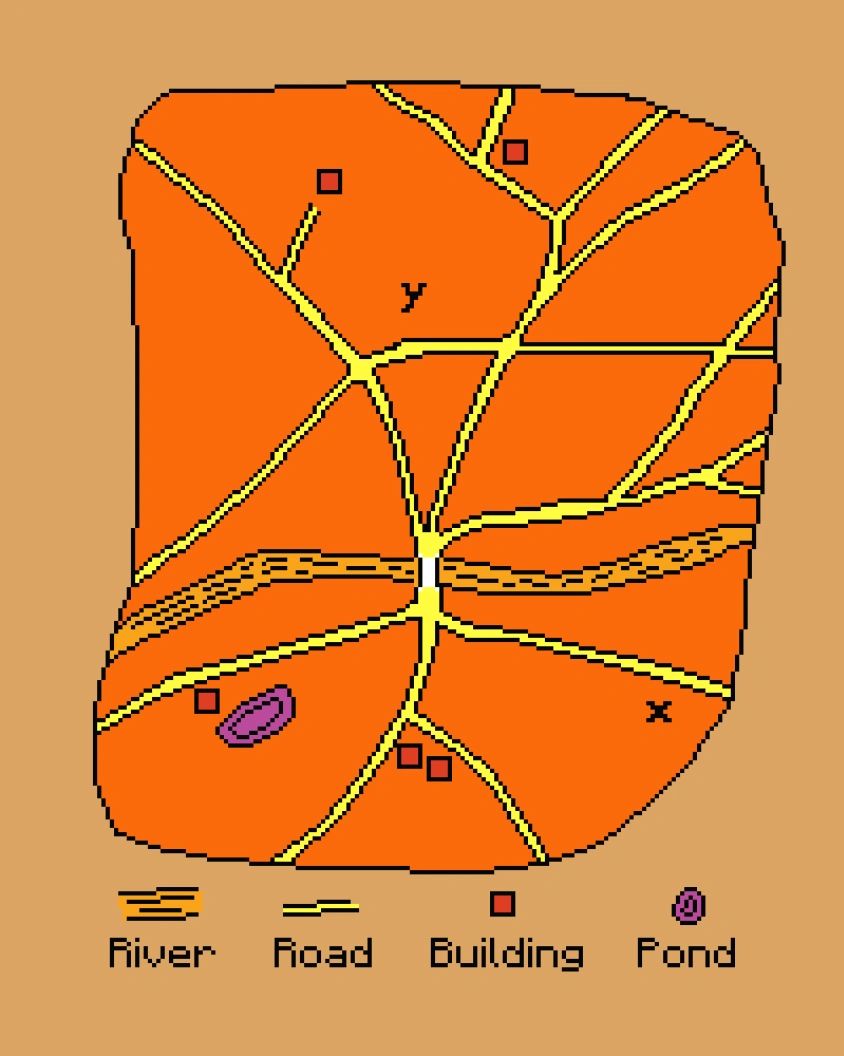
In Schelling’s actual experiments, 7 out of 8 respondents managed to meet at the bridge. Schelling’s conclusion was that people often can coordinate their intentions or expectations with others, if each knows that the other is trying to do the same and is able to find a “key”, or point of attraction: “Most situations provide some clue for coordinating behavior, some focal point for each person’s expectation of what the other expects him to expect to be expected to do.
Finding the key, or rather finding a key—any key that is mutually recognized as the key becomes the key—may depend on imagination more than on logic; it may depend on analogy, precedent, accidental arrangement, symmetry, aesthetic or geometric configuration, casuistic reasoning, and who the parties are and what they know about each other… It is not being asserted that they will always find an obvious answer to the question; but the chances of their doing so are ever so much greater than the bare logic of abstract random probabilities would ever suggest.”
While many game theorists dislike dependence on purely arbitrary devices and on cultural characteristics such as history, linguistics, or religion in determining Nash Equilibria prominence in coordination games, Dixit & Nalebuff argue the alternative: “We think it entirely appropriate that the outcome of a game played by humans interacting in a society should depend on the social and psychological aspects of the game.”
Final Thoughts
Thomas Schelling’s insight into focal points reveals something profound about human coordination: we are remarkably good at finding each other without explicit communication. The bridge on that map wasn’t objectively special—it became special because we could imagine others thinking it was special. This recursive thinking, this ability to model what others are modeling about us, transforms arbitrary features into powerful coordination devices.
What makes Schelling Points particularly fascinating is their dual nature. They emerge from both logic and imagination, from both universal human tendencies and specific cultural contexts. A bridge suggests itself as a meeting point through geometric prominence, but Times Square at noon on New Year’s Eve works because of shared cultural knowledge. Neither is inherently superior; both demonstrate our capacity to create order from potential chaos.
The implications extend far beyond parachutists with maps. Every time we successfully “read the room,” every time markets converge on a price, every time strangers coordinate without explicit agreement, we’re witnessing Schelling Points in action. They remind us that coordination isn’t just about rules and communication—it’s about shared humanity, common sense, and the remarkable ability to see ourselves through others’ eyes.
In our increasingly connected yet fragmented world, understanding how we naturally coordinate becomes ever more crucial. Schelling’s work suggests that even when formal communication breaks down, human ingenuity finds a way. We don’t need perfect information or explicit agreements; sometimes, all we need is the confidence that others are looking for the same prominent solution we are. In that mutual recognition lies both the elegance of game theory and the irreducible humanity of social coordination.
Thanks for reading!