
What Information Should Be Included In The Industry Section Of A Business Plan?
Creating a comprehensive industry section for your business plan requires thorough research and honest analysis, but the effort pays dividends. This section serves as the foundation for your entire business strategy, helping you identify opportunities, anticipate challenges, and position your venture for success.
Remember that the market and competitive analyses aren’t just academic exercises—they’re practical tools that will guide your decision-making as you launch and grow your business. The insights you gain from understanding your industry outlook, defining your target market, developing user personas, and analyzing your competition will inform everything from your pricing strategy to your marketing campaigns.
As you work through these analyses, be prepared to challenge your assumptions. Sometimes the research reveals that your initial business concept needs refinement, or that your target market differs from what you originally envisioned. This is valuable information that can save you time and resources in the long run.
Keep in mind that markets evolve, competitors emerge, and customer needs shift. Make it a practice to revisit and update your industry analysis regularly. What you learn today provides a snapshot, but staying attuned to changes in your industry landscape will help you adapt and thrive as your business grows.
The time invested in developing a thorough industry section will give you—and potential investors or partners—confidence that you truly understand the market you’re entering and have a realistic plan for success.
What Information Should Be Included In The Industry Section Of A Business Plan?
The industry section of one’s business plan should include two sub-sections – a market analysis and a competitive analysis.
Market Analysis
According to the US Small Business Administration (SBA): “You’ll need a good understanding of your industry outlook and target market. In your market research, look for trends and themes.”
This part of the business plan should demonstrate one’s knowledge regarding the industry in which his/her business is to engage. At the top level, the market analysis section provides an indication of the growth potential within an industry. The purpose of this section is much larger than an analysis of a market, however – the Market Analysis leads to the confirmation and improvement of one’s business idea and planning by defining the business’s target market and detailing its target users, as well. This then leads to the business developing financial estimates for its future and detailing the market positioning, pricing, sales and promotional strategies that will allow the company to become profitable within a competitive environment.
The Market Analysis should include an industry outlook, details on the business’s target markets, and a deep dive into user, or buyer, personas. The Market Analysis should also provide basic statistics and key information from any marketing research data thus far obtained; however, itemized details of market research studies should be placed in the Appendix section of the business plan.
Industry Outlook
The Industry Outlook is a summary of one’s market research, defines the market in terms of demand, size, trends, and growth potential, and should provide the following information in order to get a good sense of one’s market:
- Total market size
- Demand
- Trailing , current, and expected growth rates
- Market trends and characteristics, such as the life cycle stage of the industry
Target Market
Once the Industry Outlook has been completed, the Target Market section of the business plan can be detailed. The Target Market explains how the company fits within the industry, reiterates the business’s strengths, and narrows the industry’s total market by concentrating on segmentation factors that determine the business’s addressable market – the actual number of users within the sphere of the business’s influence. The purpose of the addressable market determination is to answer the questions: “What is the expected consumer demand for my product or service?”, “What gap within the market does my business fill?”, and “What are the various opportunities and limitations for my business gaining customers?”
When defining a target market, it’s vital to narrow the group to a realistic volume. That said, it is worth noting that the addressable, or feasible, market is the portion of the market that can be captured provided every condition within the environment is perfect and that there is very little competition – a situation that rarely occurs, if ever. Within the Target Market section, one should gather information that identifies the following:
- Key characteristics of the primary group to be targeted. This segment should include information about the critical needs of future customers, the level to which those needs are currently being met, and the demographics of the group (not the individual user). Also identify any seasonal or cyclical trends that may impact the industry or the business model.
- Size of the target market, including expected market growth for this group and, broadly, the geographic areas inhabited.
- The magnitude to which a business expects to obtain market-share, the ease with which this market-share is expected to be obtained, and why this growth is expected.
- Trends that affect potential customers, coupled with fundamental features of the subsequent markets. As with the primary target market, it is important to pinpoint the needs, demographics and developing trends that are going to affect the secondary markets later.
User Personas
Full profiles can be created for target customers once the Target Market has been clarified. Referred to as “User” or “Buyer” Personas, these profiles gather information intended to shed light on exactly who the customer is, where they will be found, how to reach them, and, most importantly, how the business’s product or service will be sold to a specific customer type. Consider this – in what ways are the Target Market and User Personas different, how are they similar, and what if-this-then-that conclusions can be made from the data? A full profile for a single User Persona should include information on Demographics, Geographics, Psychographics, and Behavioral Attributes:
- Demographics – age, gender, income, education, occupation, marital status, family, wealth
- Geographics – location (country, region, state, city, town), climate, culture
- Psychographics – lifestyle, attitudes, risk tolerance, aspirations, personality, values, struggles, pain points, goals, interests, needs, problems
- Behavioral attributes – preferred channels and content types, loyalty, frequency of purchases, affiliations, shopping and buying habits and patterns, media frequented
Competitive Analysis
According to the US Small Business Administration (SBA): “Competitive research will show you what other businesses are doing and what their strengths are. What do successful competitors do? Why does it work? Can you do it better? Now’s the time to answer these questions.”
The competitive analysis should identify the business’s competition by product line or service and market segment, and assess the competitive landscape in terms of market share, strengths and weaknesses, window of opportunity to enter the market, and barriers to market entry. The Competitive Analysis also identifies the importance of the business’s target market relative to its competitors and the ways in which indirect and secondary competitors may impact one’s business success.
The S.W.O.T Analysis
This is where competitive SWOT Analysis will be conducted, identifying competitor Strengths, Weaknesses, Opportunities, and Threats. SWOTs look at the internal and external environments in which a business operates, and are often an early step in a Risk Assessment. Questions to answer in the Competitive Analysis, such as “Who is the competition?”, “How will the business be differentiated?”, and “How many similar options are already available to consumers?” (market saturation), should all be answered through the SWOT.
Strengths
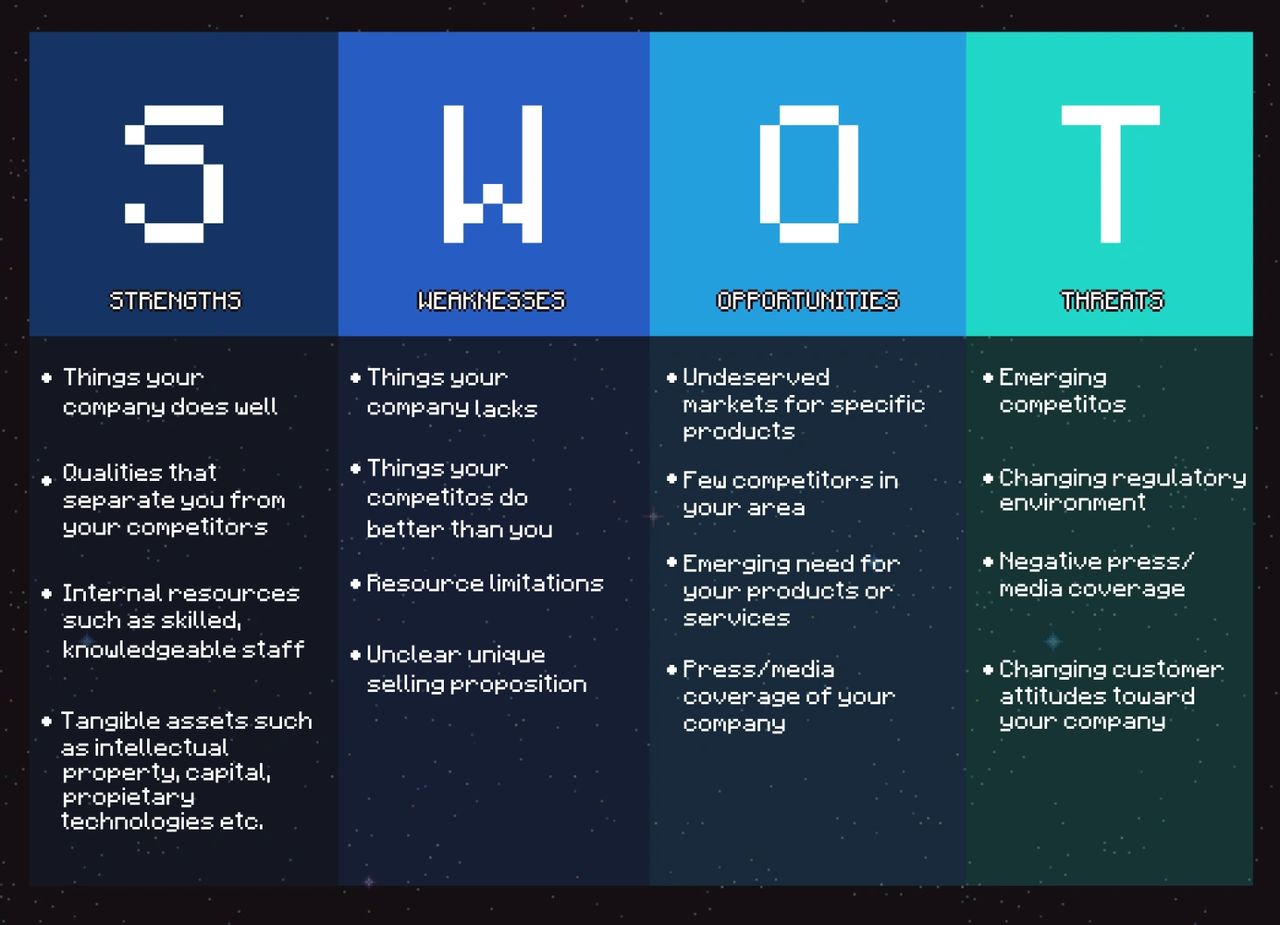
Strengths refer to what a business does well, tangible assets and internal resources, and what sets the business apart from the competition.
Weaknesses
Weaknesses include areas where the business needs to improve, resource limitations, and places where competitors are excelling.
Opportunities
Opportunities refer to the industry as a whole, including underserved markets, lack of competitors, growing popularity for the products/services one’s business provides, and positive media coverage of the industry.
Threats
Threats include parts of the external environment that could potentially harm one’s business, such as new laws and regulations, negative media coverage, decline of one’s industry, and emerging competitors.
While conducting a competitive SWOT Analysis, it is critical to identify the competition’s product-lines or services, market segment, and market share – Use this information to determine competitor strengths, weaknesses, and opportunities in order to better understand threats such as:
- The relationship between one’s target market and one’s competitors
- Roadblocks that may interfere with entering the marketplace
- When new competitors will enter into the marketplace
- The limits of time on one’s window of opportunity
The structure of a SWOT analysis is shown in the image below.
Final Thoughts
The industry section of your business plan is where theory meets reality. While it’s tempting to rush through market research and competitive analysis to get to the “exciting” parts of your business plan, resist that urge. The data you uncover here will either validate your business idea or reveal critical flaws before you invest significant time and money.
Pay special attention to the gaps between what you think you know and what the data actually shows. If your research reveals that your assumed target market is too small, your competition too entrenched, or industry trends moving against you, consider it a gift rather than a setback. Better to pivot now than fail later.
One often-overlooked benefit of thorough industry analysis is how it prepares you for investor conversations. When you can speak confidently about market size, growth rates, and competitive positioning—backed by solid data—you demonstrate the kind of strategic thinking that attracts funding and partnerships.
Finally, don’t let perfectionism paralyze you. Your industry analysis will never be 100% complete because markets are dynamic. Do your due diligence, gather enough information to make informed decisions, and then move forward. You can always refine your understanding as you engage with actual customers and learn from real-world feedback.
The goal isn’t to predict the future perfectly—it’s to enter your market with eyes wide open, ready to capitalize on the opportunities you’ve identified while navigating the challenges you’ve anticipated.
Thanks for reading!