What Rights Does A Copyright Provide?
In today’s creative economy, understanding copyright law isn’t just for lawyers—it’s essential knowledge for anyone who creates, shares, or uses creative content. Whether you’re a photographer protecting your images, a business owner using stock photos, or a content creator navigating the digital landscape, copyright affects nearly every aspect of how we interact with creative works.
At its core, copyright law grants creators a powerful bundle of exclusive rights that control how their work can be used, shared, and monetized. These rights form the foundation of the creative industries, from publishing and music to software and digital media. Yet despite their importance, many people remain unclear about what exactly copyright protects and what rights it provides.
This article breaks down the six exclusive rights that copyright law grants to creators under US law. We’ll explore how these rights work in practice, why the distinction between ideas and expression matters, and how licensing agreements enable creators to share their work while maintaining ownership. Whether you’re looking to protect your own creative output or ensure you’re using others’ work legally, understanding these fundamental rights is your first step toward navigating the world of intellectual property with confidence.
What Rights Does A Copyright Provide?
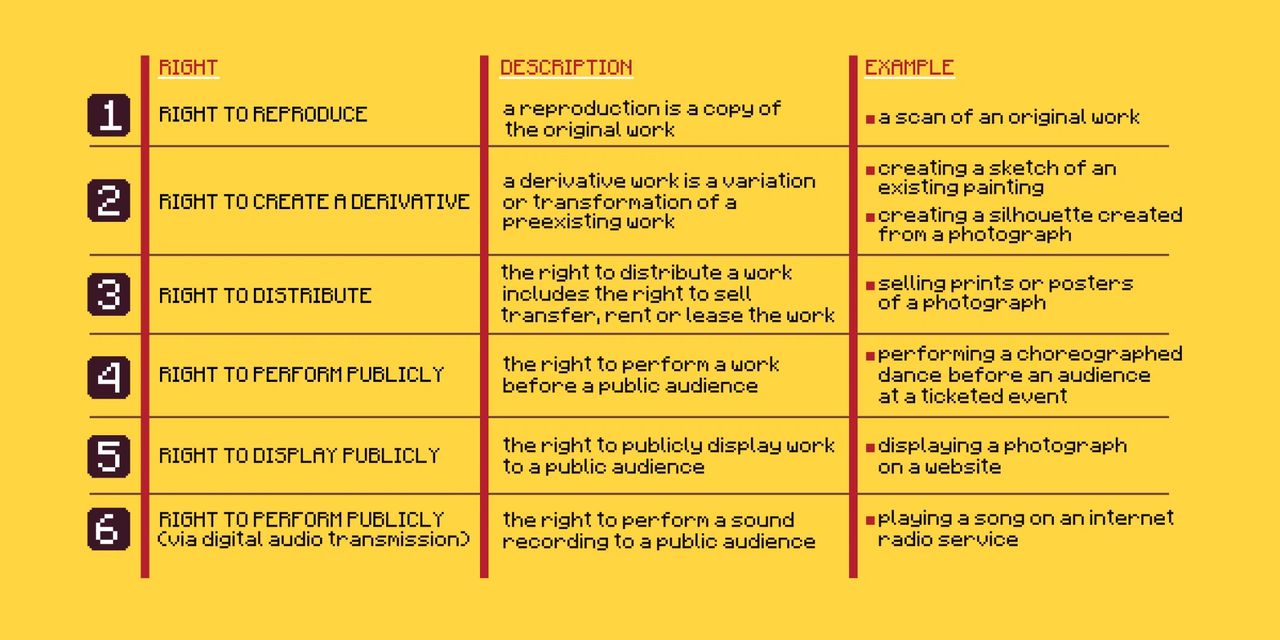
A copyright protects expression, never ideas, procedures, methods, systems, processes, concepts, principles, or discoveries, and US Copyright law provides copyright owners with the following exclusive rights:
The Right To Reproduce – Reproduce the work in copies or phonorecords.
The Right To Create A Derivative – Prepare derivative works based upon the work.
The Right To Distribute – Distribute copies or phonorecords of the work to the public by sale or other transfer of ownership or by rental, lease, or lending.
The Right To Perform Publicly – Perform the work publicly if it is a literary, musical, dramatic, or choreographic work; a pantomime; or a motion picture or other audiovisual work. Perform the work publicly by means of a digital audio transmission if the work is a sound recording.
The Right To Display Publicly – Display the work publicly if it is a literary, musical, dramatic, or choreographic work; a pantomime; or a pictorial, graphic, or sculptural work. This right also applies to the individual images of a motion picture or other audiovisual work.
The Right To Perform Publicly – This regards digital audio transmissions, and provides the right to perform a sound recording to public audiences.
In addition to the six exclusive rights detailed above, copyright provides creators of original works with the power to grant anyone, through a licensing agreement, authorization to use the creators’ works and to exercise the exclusive rights provided by copyright, subject to certain statutory limitations.
The term “licensing agreement” refers to a legal, written contract between two parties wherein the property owner (the licensor) gives permission to another party (the licensee) to use the owner’s brand, patent, or trademark. Unlike the sale of an asset, the licensor continues as the ultimate owner of the asset or methodology; limited rights to use what the licensor owns are transferred, not ownership. Typically, a licensing agreement contains details on what is required of both parties, compensation, and terms of usage
Final Thoughts
Understanding copyright rights is fundamental for both creators and users of creative works in our digital age. These six exclusive rights form the backbone of intellectual property protection, empowering creators to control how their expressions are used while fostering innovation through licensing arrangements.
It’s crucial to remember that copyright protects the specific way ideas are expressed, not the ideas themselves. This distinction allows for a vibrant marketplace of creativity where similar concepts can coexist in different forms. Whether you’re an artist, writer, musician, or entrepreneur, knowing these rights helps you navigate the complex landscape of creative ownership.
For creators, these rights represent both protection and opportunity—the ability to safeguard your work while potentially monetizing it through strategic licensing. For those seeking to use copyrighted works, understanding these rights ensures you can engage with creative content legally and ethically.
As technology continues to evolve and new forms of expression emerge, these fundamental rights remain the cornerstone of creative protection. By respecting copyright and leveraging licensing agreements appropriately, we can maintain a healthy ecosystem where creativity thrives and innovation flourishes.
Thanks for reading!