
What Are The Functional Task And Social Roles Of Group Members?
Some roles are common amongst most groups and tend to emerge spontaneously. Separated by sociologists into either “task roles” or “social roles”, these “unformalized behavior patterns” and “situational identities”, develop over time and through sustained interactions in group settings, according to R.H. Turner in ‘Handbook Of Sociological Theory’.
The idea Turner put forward on role theory is that a community cohesion (requiring culture, norms, social capital, trust, cooperation, plus coordination) is created by members properly acquiring and executing these various task and relationship roles so long as the “clustering of goals, activities, and sentiments” that form the roles also “maximize mutually reinforcing elements and minimize contradictory effects.”
The Functional Task Roles Of Group Members
Functional task roles in groups can be found below, adapted from ‘Functional Roles of Group Members’ by K. D. Benne and P. Sheats, Journal of Social Issues, 1948.
- Initiator/contributor: Recommends novel ideas about the problem at hand, new ways to approach the problem, or possible solutions not yet considered
- Information seeker: Emphasizes getting the facts by calling for background information from others
- Opinion seeker: Asks for more qualitative types of data, such as attitudes, values, and feelings
- Information giver: Provides data for forming decisions, including facts that derive from expertise
- Opinion giver: Provides opinions, values, and feelings
- Elaborator: Gives additional information, examples, rephrasings, implications about points made by others
- Coordinator: Shows the relevance of each idea and its relationship to the overall problem
- Orienter: Refocuses discussion on the topic whenever necessary
- Evaluator/critic: Appraises the quality of the group’s methods, logic, and results
- Energizer: Stimulates the group to continue working when discussion flags
- Procedural technician: Cares for operational details, such as materials, machinery, and so on
- Recorder: Takes notes and maintains records
The Functional Social Roles Of Group Members
Functional social roles in groups can be found below, adapted from ‘Functional Roles of Group Members’ by K. D. Benne and P. Sheats, Journal of Social Issues, 1948.
- Encourager: Rewards others through agreement, warmth, and praise
- Harmonizer: Mediates conflicts among group members
- Compromiser: Shifts his or her own position on an issue in order to reduce conflict in the group
- Gatekeeper/expediter: Smooths communication by setting up procedures and ensuring equal participation from members
- Standard setter: Expresses or calls for discussion of standards for evaluating the quality of the group process
- Group observer/commentator: Points out the positive and negative aspects of the group’s dynamics and calls for change if necessary
- Follower: Accepts the ideas offered by others and serves as an audience for the group
Can One Person Fulfill Both Functional Roles – Task & Social?
Yes, it is possible for one person to fulfill both task and relationship roles at the same time, but “Few people have the interpersonal and cognitive skills needed to enact both roles successfully,” according to Donelson Forsyth in ‘Group Dynamics’. P.J. Burke agrees with Forsyth in stating, “Because the task specialist is himself the principal source of tension it is unlikely that he would be effective in resolving this tension, and, if the tension is to be reduced, someone other than the task leader must assume a role aimed at the reduction of interpersonal hostilities and frustration.” – ‘The Development Of Task And Social-Emotional Role Differentiation’
Personality & Roles Are Linked In Practice
Referencing the above work of Benne and Sheats, Manabu Fujimoto states that there are theoretical problems in a two category role structure: “A simple structure of two categories based solely on function is insufficient for classifying the various team roles”, because, in actuality, “personality and roles are linked.” As it presents “unspecialized roles and behaviors”, Fujimoto continues, the Benne and Sheats “structure is one-dimensional” and “unable to categorize complex team roles adequately”, resulting in “overly fragmented roles as well as oversimplified categories.” – ‘Team Roles And Hierarchic System In Group Discussion’.
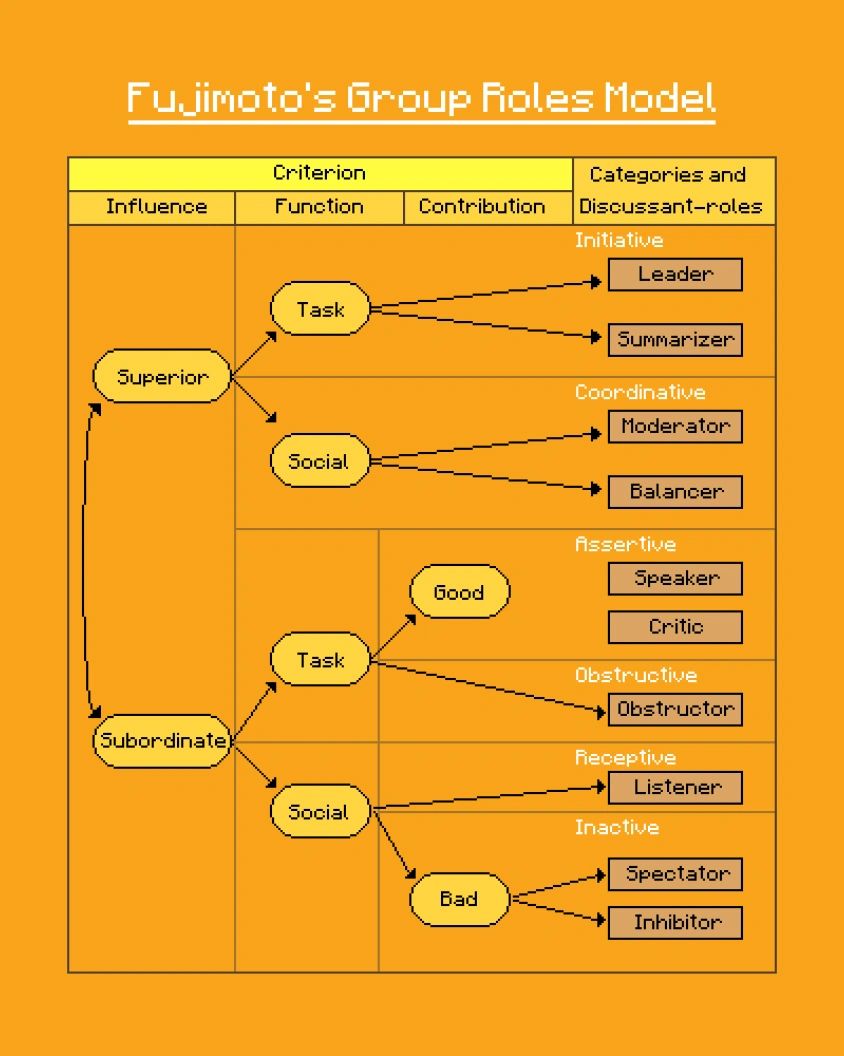
Fujimoto suggests a “three-criterion model based on the structure of deep roles“: Rather than task and social-oriented functional roles, his model’s criterion are influence, function, and contribution. Manabu Fujimoto’s Group Roles Structure, based on deep roles, is illustrated below.
Note that the “Superior” enacts both task and social behaviors as a function of role.
Final Thoughts
Understanding the dynamics of task and social roles within groups reveals the intricate balance required for effective collaboration. While Benne and Sheats’ foundational framework provides valuable insights into how individuals naturally gravitate toward either task-oriented or relationship-oriented behaviors, the reality of group dynamics is far more nuanced. As Turner’s role theory suggests, successful groups depend on members who can navigate these roles fluidly, creating a cohesive environment where both productivity and interpersonal harmony can flourish. The challenge lies not just in identifying these roles, but in recognizing how they shift and evolve through sustained group interaction.
The tension between task achievement and relationship maintenance presents an ongoing challenge in group settings. While task specialists drive progress and ensure objectives are met, they often inadvertently create friction that requires others to step in as harmonizers or encouragers. This dynamic highlights why few individuals successfully embody both roles simultaneously—the very behaviors that make someone effective at pushing for results can undermine their ability to soothe tensions and build consensus. Yet this limitation isn’t necessarily a weakness; rather, it underscores the value of diverse team composition where different members can complement each other’s natural tendencies.
Fujimoto’s three-criterion model offers a more sophisticated lens through which to view group dynamics, acknowledging that personality and role are inextricably linked. By introducing influence and contribution alongside function, this framework better captures the complexity of real-world group interactions. The recognition that some roles, like the “Superior,” naturally encompass both task and social behaviors points toward a more integrated understanding of leadership and group effectiveness. As we continue to work in increasingly diverse and complex team environments, appreciating these multidimensional aspects of group roles becomes essential for fostering both productivity and positive group experiences.
Thanks for reading!