
Why Care About Roles? Social Dilemmas, Exchange Relationships, And Psychological Needs
According to R.H. Turner, a role is a “cluster of behaviors and attitudes that are thought to belong together” and role players are “guided by a set of expectations… so that an individual is viewed as acting consistently when performing the various components of a single role and inconsistently when failing to do so.” – ‘Handbook Of Sociological Theory’ – Chapter 12, ‘Role Theory’. Roles are an essential component of group structure, as are norms and networks of relationships, and the number of roles in a group, the type of roles, and the distribution of members in those roles can point to a group’s functioning and health, as well as trust, reciprocity, and social capital levels amongst members.
Today we will consider three key benefits of appropriate role allocation with which one should be familiar – the resolution of pervasive social dilemmas, the establishment of foundational exchange relationships, and the satisfaction of various psychological needs.
Resolution Of Social Dilemmas
According to Britannica, a role provides “a means of identifying and placing an individual in a society”. Roles not only define one’s responsibilities within a community, but also facilitate cooperation and coordination of group efforts and resources for the mitigation of the various “tragedies of the commons”, such as the “Prisoner’s Dilemma” and the “Stag Hunt”, by “creating a set of shared expectations that script the behavior of the individuals who occupy them,” as said by Donelson Forsyth in ‘Group Dynamics’.
And, on the resolution of social dilemmas through the creation of social capital, according to Manabu Fujimoto: “… roles within teams promote team cohesion and responsibility, foster positive interdependence and individual accountability, and stimulate members’ awareness of the overall group performance and of each member’s contribution.” – ‘Team Roles And Hierarchic System In Group Discussion’.
Establishment of Foundational Exchange Relationships
The collaborative group creates a fluid marketplace for the exchange of many types of value, from intangible commodities, such as knowledge and human attention, to tangible commodities, such as goods and services. According to Donelson Forsyth: “By enacting roles, individuals establish an exchange relationship with their fellow members, building the interdependence that is essential for the coordination of behavior, group cohesion, and productivity.” – ‘Group Dynamics’. Stryker & Burke continue the thought when stating that the status, respect, and esteem acquired through role achievement are “symbolic, representing potential resources available for successful task accomplishment.” – ‘The Past, Present, And Future Of Identity Theory’
Satisfaction Of Psychological Needs
According to Donelson Forsyth, “Roles exist in groups to fulfill, at least in part, personal and interpersonal needs.” – ‘Group Dynamics’. Stated by R.H. Turner, “social roles provide the principal organizing framework for self-conception.” – ‘Handbook Of Sociological Theory’. And, finally, as said by Stryker & Burke, “role choices are a function of identities conceptualized.” – ‘The Past, Present, And Future Of Identity Theory’.
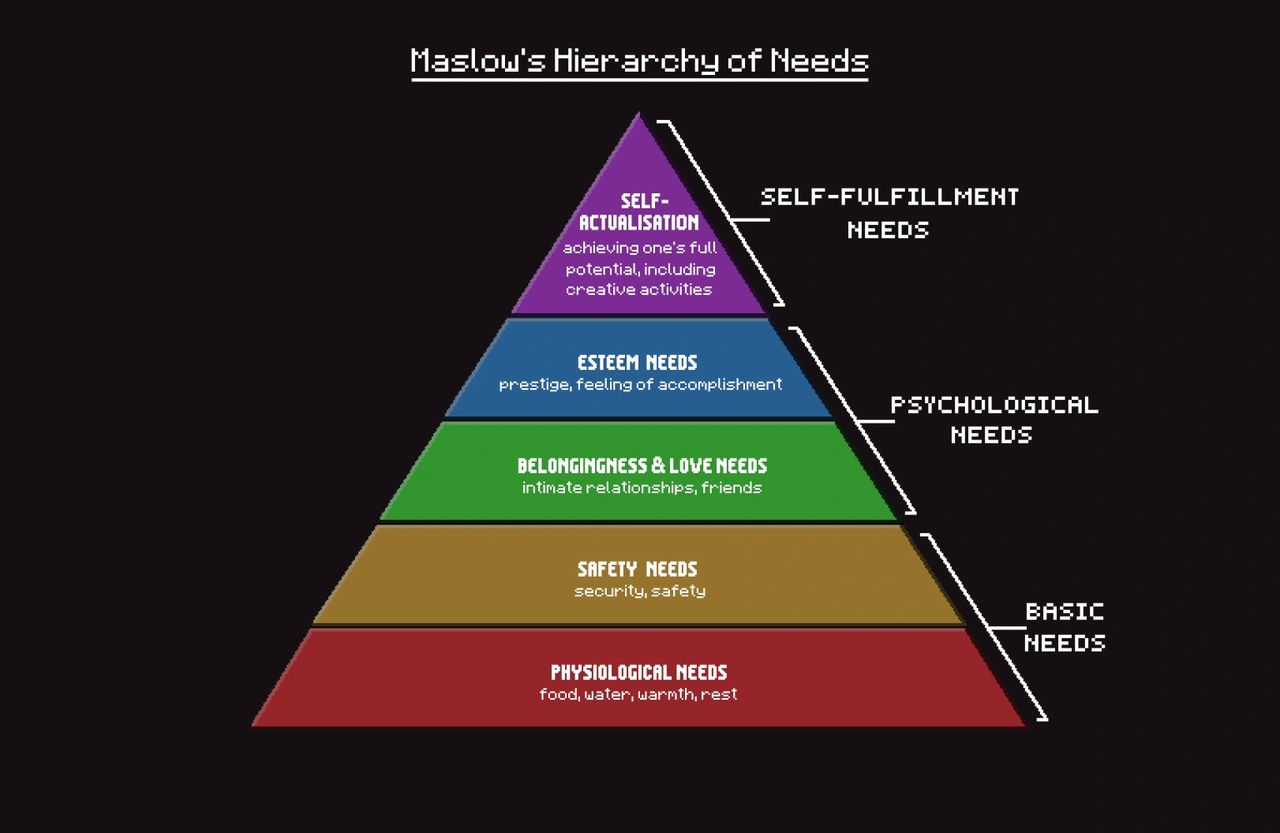
While Turner distinguishes between the prestige that is “derived from mere incumbency in a highly respected role” and the esteem that is “based on the adequacy with which the role is performed”, Maslow, in his Hierarchy Of Needs refers to prestige rather as one of several of needs in the “Esteem Needs” group of the Psychological Needs category, as shown in image below. Considered as a “power motive” and “need for power”, one’s need for esteem, according to Maslow, is an inherent and natural state of being: “All people in our society have a need or desire for a stable, firmly based, (usually) high evaluation of themselves, for self-respect, or self-esteem, and for the esteem of others. By firmly based self-esteem, we mean that which is soundly based upon real capacity, achievement and respect from others.”
Final Thoughts
The exploration of roles reveals their fundamental importance as organizing principles in human social life. Far from being mere labels or arbitrary assignments, roles serve as the connective tissue that binds individuals into cohesive, functioning groups. They transform collections of people into purposeful communities by providing clarity of purpose, establishing mutual expectations, and creating the framework within which cooperation becomes not just possible, but natural. When we understand roles through this lens, we see them not as constraints but as enablers—structures that paradoxically free us to contribute meaningfully by defining the space within which our contributions matter most.
What emerges most clearly from examining roles through multiple theoretical perspectives is their multifaceted nature. Roles simultaneously solve practical problems of coordination while fulfilling deep psychological needs for identity and belonging. They create the conditions for trust and reciprocity to flourish by establishing predictable patterns of interaction, yet remain flexible enough to accommodate individual expression within their boundaries. This dual nature—structured yet adaptive, collective yet personal—makes roles particularly suited to addressing the complex challenges of group life. Whether we’re navigating the commons, building exchange networks, or seeking recognition and purpose, roles provide the scaffolding that makes collective human achievement possible.
As we move forward in an increasingly interconnected world, the wisdom embedded in role theory becomes ever more relevant. Understanding how roles function—how they resolve dilemmas, facilitate exchange, and satisfy human needs—equips us to build better teams, stronger communities, and more effective organizations. The key insight is that roles are not static impositions, but dynamic agreements, constantly negotiated and refined through our interactions. By consciously attending to role creation and allocation, we can design social structures that bring out the best in human nature while mitigating our tendencies toward conflict and free-riding. In this way, the study of roles offers not just theoretical understanding but practical tools for creating the kinds of groups and communities in which we all wish to belong.
Thanks for reading!